 How to resolve AdBlock issue?
 Darmstadt State Theate relies on Lawo
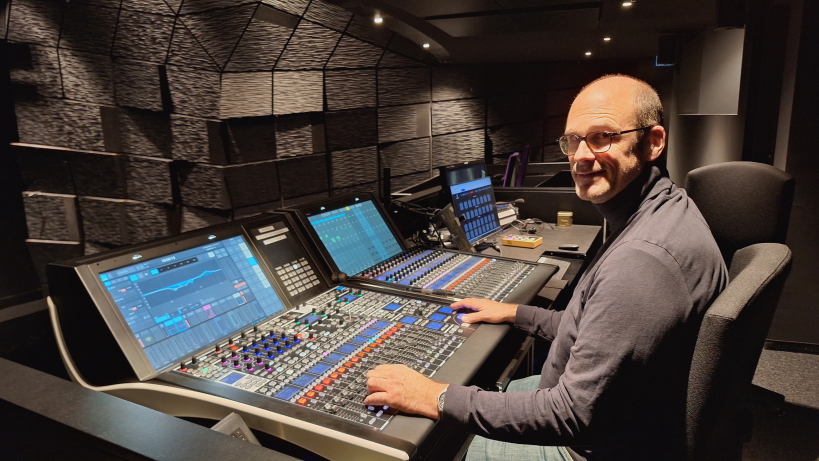
Picture: Sebastian Franke
As part of an extensive modernization, Darmstadt State Theater has upgraded its audio infrastructure with a fully IP-based solution from Lawo to meet current and future demands for advanced sound reinforcement and recording purposes. The new audio setup in the Kleines Haus (Small Stage) includes two mc²56 MkIII production consoles with 16 faders each, complemented by two additional 16-fader extender units. The system also features multiple A__stage and A__mic8 stage boxes, an A__UHD Core licensed for 768 DSP channels, and centralized control via the HOME platform. Built on RAVENNA/AES67 Audio-over-IP, the infrastructure supports multi-user workflows, redundancy, high flexibility, and full interoperability. System integration for all venues and the recording studio was handled by long-standing partner digitech.
“The Lawo mc²56 MkIII was the ideal choice for our new audio infrastructure,” explains Sebastian Franke, Head of Sound. “It not only delivers the performance and feature set required for large-scale productions, but its modular user interface gives us maximum flexibility.” Franke continues: “We now have an mc²56 console with 16 faders at the FOH position and an identical unit in the sound control room, plus two 16-fader extenders that we can deploy wherever needed. During rehearsals, we often place them in the middle of the auditorium - because that’s the only position where we can accurately hear the 3D sound image. At FOH, the ceiling speakers aren’t audible, so moving into the auditorium is essential for immersive checks.”
At the core of all mc²56 consoles are A__UHD Core Audio Engines, each providing 1,024 DSP channels to handle the most demanding audio tasks. Integration into the existing audio infrastructure is achieved via A__stage I/O units and Power Core devices, ensuring seamless signal distribution throughout the theater. “We’re extremely satisfied with this decision,” says Franke. “We’ve worked with Lawo for years, sharing our views and requirements at trade shows and workshops - and many of our suggestions have been implemented in the mc²56 MkIII. Plus, support is always close at hand.”
As part of the overall modernization, the recording studio was equipped with Lawo’s AoIP infrastructure in 2024, following the main stage upgrade in 2023. “The recording studio now features an mc²56 console that integrates tightly with the systems in both the Main Stage and Small Stage. Once the HOME systems are fully connected, we’ll be able to route signals directly from the choir hall or musical theater stage to the main house - without anyone needing to sit in the studio,” Franke explains. Uniform user interfaces and centralized network architecture simplify workflows: “The most complex workstation in the theater - the mixing console - is now identical in both venues, so every sound engineer feels at home.”
System integration also includes Waves SoundGrid, Lawo Virtual Sound Card (VSC) for macOS, RTW TM7 loudness metering, and the browser-based VisTool interface. Fourteen stage boxes from the A__stage series, including two A__mic8 units with ST2022-7 Class C redundancy, guarantee low-latency, fail-safe connectivity between stage, orchestra pit, and production areas.
The premiere of the fairy tale production Tom Sawyer marked the first live test in the Small Stage theater. "We spent most of the time working with the console and the 16-fader extender in the last row, plus a monitor for playback. Everything worked flawlessly,“ reports Franke. Despite a modest channel count (6 wireless lavaliers plus playback), the team was able to map all functions professionally. “The scalability of the Lawo system makes it easy to adapt to any production - wherever and however we need it.” Franke concludes: “We now have a highly networked, scalable infrastructure that allows us to manage even the most complex productions efficiently and reliably - from rehearsals to opening night.”