 How to resolve AdBlock issue?
 Sennheiser Spectera for Notre-Dame de Paris
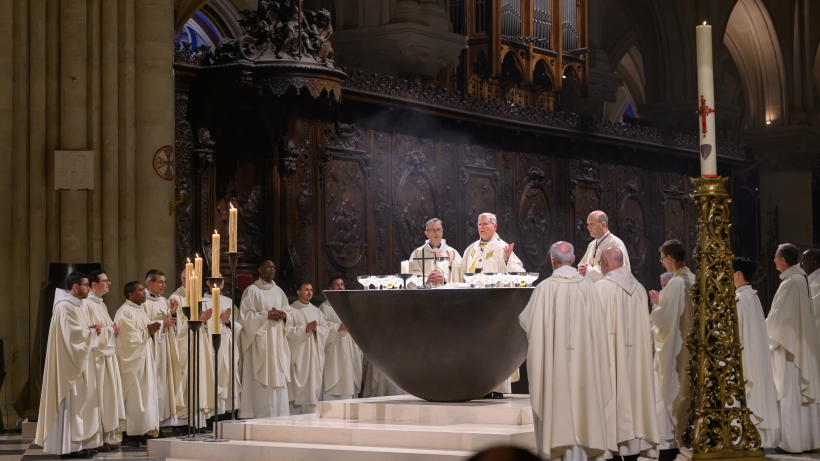
Picture: Jean-Baptiste Delerue
After the terrible fire, it took only five years of – albeit extremely intensive – work to rebuild the Notre-Dame de Paris cathedral. Novelty, the integrator responsible for re-equipping Notre-Dame, was consulted two years prior to the cathedral’s reopening to supply a new sound system, with the specifications calling for expanded coverage while keeping all technical equipment as discreet as possible. After an in-depth study, it became clear that only Sennheiser’s Spectera wideband wireless system ticked all the boxes of the stringent specifications.
When David Créteur, project lead at Novelty, started to look into the RF wireless equipment for the cathedral, he quickly realised they needed a new solution that would satisfy the demands that came with the reconstruction of Notre-Dame de Paris. The new specifications included sound reinforcement for mobile celebrations, where the priests or the archbishop would move about whilst still being heard clearly without any dropouts. In addition, the use of new spaces such as the side chapels had to be factored in. In a nutshell: RF coverage had to be ensured throughout the entire length of the cathedral, from the entrance of Notre-Dame to the chapel of the Crown of Thorns reliquary located at the very back, and across its width, where obstacles like wooden partitions and massive stone pillars had to be overcome.
Beyond ensuring reliable RF coverage across almost the entire cathedral, Créteur was looking for a system that was discreet and easy to operate, knowing that Notre-Dame has to combine spiritual life with welcoming the public. As a place of worship, Notre-Dame de Paris has always been freely accessible to all. “Notre-Dame is a place of sharing open to all visitors, whether they wish to attend a service or just want to walk under its vaults,” says Laurent Prades, technical manager of Notre-Dame de Paris. “This is what makes this cathedral so unique: It welcomes the whole world, worshippers and visitors alike, with services being held during visits, and visits continuing during services.”
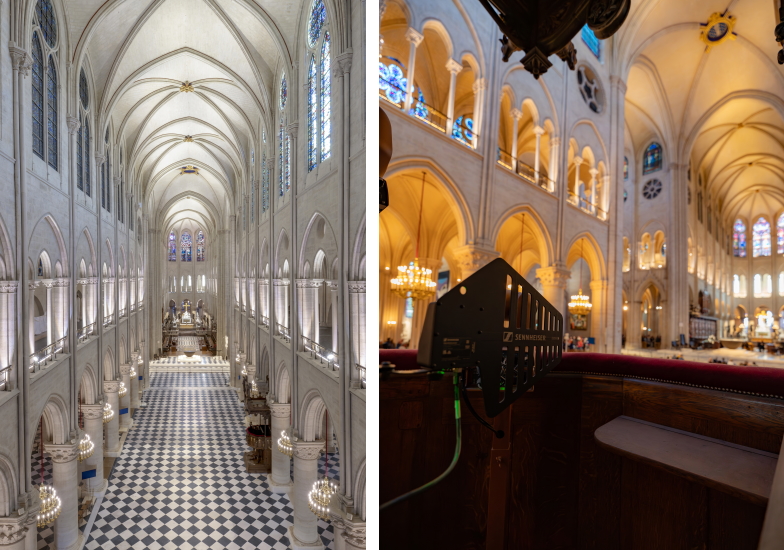
Pictures: Julio Piatti, Notre-Dame (left); Olivier Allard (right)
In view of the new requirements and the exceptional operating conditions, the question was which wireless system to use? Notre-Dame’s old system relied on an analogue two-channel Sennheiser 3000 series receiver and a pair of active directional antennas placed at the centre of the liturgical podium. This heritage system was testament to the effectiveness and long-term reliability of Sennheiser wireless, but given the area to be covered, Créteur felt it was time to move on from analogue: “Instead of working only along the axis, we now had to cover almost the entire cathedral, which is just over a hundred metres long from the entrance to the back and almost 50 metres wide at the transept.
Turning away from traditional RF wireless technologies, which were decidedly too complex to implement, Créteur briefly considered switching to a DECT-based solution. Then, during a chance encounter with a Sennheiser presentation, he discovered the possibilities offered by Sennheiser’s WMAS implementation, the new Spectera system: “The further we got into the presentation, the more Spectera seemed to solve the problems one by one, and to perfectly meet the specific requirements of our project by considerably simplifying the system and its installation. First of all, unlike traditional wireless systems, Spectera does not need diversity, so with comparable or even superior coverage, we can go from eight antennas to four, which halves the cabling. Secondly, the antennas combine perfectly without the need for a technician to intervene, eliminating the operational difficulties associated with zoning. And finally, the antennas are connected via Ethernet cables, a standard that is easier to integrate and more affordable than coaxial cable.”
However, in view of the specifications, the team planned to wire the entire Notre-Dame cathedral with fibre rather than RJ45: “When Sennheiser confirmed that a fibre extension works perfectly by simply adding a fibre media converter from the list of models they had tested, we realised that Spectera was the solution we were looking for.”
Notre-Dame’s technical rack is strikingly simple and compact, with the Spectera Base Station occupying a single rack unit while allowing the use of up to 32 microphones and 16 stereo IEMs. With a traditional system, the necessary components would have required much more space and higher electricity consumption. Spectera directly integrates with a DiGiCo console via Dante, using a 4ERA4 matrix, which allows for simple and smooth transport and distribution of audio channels to the console. Initially planned to be located on the gallery at a height of around ten metres, the four antennas were ultimately brought down, providing very stable coverage throughout the cathedral.