 How to resolve AdBlock issue?
 Andrew Scott Bell relies on Focusrite
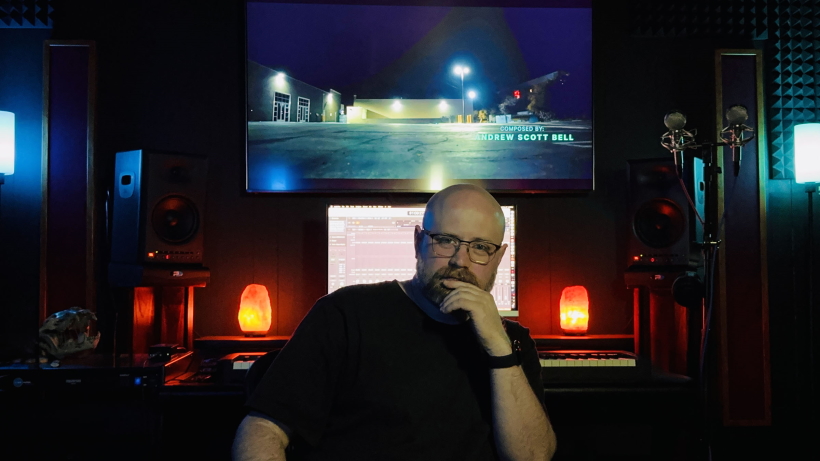
L.A.-based film and television composer Andrew Scott Bell has integrated the Focusrite fourth-generation Scarlett 18i20 into his scoring workflow, using the interface’s expanded functionality and audio quality to support the demanding creative process behind his prolific career in film and television.
Working from a streamlined studio in Los Angeles, the composer keeps his production environment intentionally simple yet flexible, with the focus on creativity. Bell’s setup centers around a Mac Studio computer, professional studio monitors, a Blackmagic hard drive bay used to run session files, and several additional drives dedicated to large sound libraries and virtual instruments. For I/O, Bell has been using Focusrite interfaces since moving to Los Angeles in 2015. “Focusrite has been wonderful. It has a great sound to it,” he proclaims, noting his first interface was a Scarlett 2i4. “I kept that interface as my travel rig for years. Early on I was mostly recording stereo violin parts or acoustic instruments for indie film projects, so two inputs were all I needed.”
As Bell’s career expanded into larger projects, including network television, his recording needs grew as well. His need to capture his own performances of violin, cello, trumpet, clarinet and several unconventional instruments he has developed or commissioned led to the adoption of the fourth-generation Scarlett 18i20 as an integral part of capturing his parts efficiently. “I’m really loving it,” he shares. “Some of these new features are things I’ve been wanting from the Scarlett series for years.” The move to the Scarlett 18i20 allows Bell to keep multiple microphone setups permanently connected around the studio. “I like having different mic setups ready to go,” he explains. “For example, I always keep a pair set up for a deconstructed upright piano and another pair positioned for instruments like marimba or wood percussion so I can just arm the track and hit record.”
A favored Scarlett 18i20 feature Bell highlights is the ability to link stereo microphone pairs directly on the interface, an especially valuable tool when capturing stereo recordings of layered instrumental performances. “When I’m scoring a film, I record a lot of the instruments myself and layer them sometimes over a dozen times,” Bell explains. “Being able to link stereo inputs and control the gain together makes it easy to maintain a balanced stereo image.”
Bell also appreciates the practical studio workflow improvements introduced in the latest generation of Scarlett interfaces, including mirrored front and rear inputs. This allows him to keep his primary studio microphones permanently connected while quickly switching to other mics when needed for voice calls, interviews or scratch recordings. “It’s those little details that make the recording experience more seamless,” he says. “They keep the flow of creativity going.” Bell also points to the interface’s enhanced Air modes, which add presence and character to recordings. “The Air option adds a sparkly top end, but the second setting also brings in a warm mid-range character that almost feels like tube saturation. It sounds fantastic.”
Bell describes the sonic improvement of the latest Scarlett generation as subtle but inspiring. “The best way I can describe it is that it sounds crisp,” he says. “Those crispy highs help the subtle areas of my music stand out more. It feels like a true representation of what I’m writing.” For Bell, however, the most important factor is the inspiration that comes from reliable, accurate sound. “The audio quality feels true to the music I know intimately,” he says. “When I’m writing, I want the sound to inspire me – and Focusrite inspires!” Bell also credits the interface’s plug-and-play design for helping him stay focused on composing rather than troubleshooting gear. “What I really love about Focusrite is the ease and intuitiveness,” he says. “You plug it in, boom, it sounds great. The quality is there right out of the box, and that frees me up to just be creative.”
“I’ve always wanted to be part of storytelling, and music is the way I approach that,” says Bell. Since 2009, he has scored nearly 100 film and television projects, including scoring NBC’s Home Sweet Home, Powder Pup from Lionsgate, Lifetime’s Psycho Storm Chaser, and the viral horror phenomenon Winnie-the-Pooh: Blood and Honey and its sequel. Bell has also composed an opera based on Nobel Peace Prize winner Elie Wiesel’s play The Trial of God. Today, from his Los Angeles studio, Bell continues to score a wide range of projects, supported by tools like the Focusrite Scarlett 18i20 that help translate cinematic ideas into finished music. “I want the creative process to feel effortless,” Bell says. “The tools should disappear so the music can happen.”