 How to resolve AdBlock issue?
 SYNTH-WERK SW 735 MK2 BODE Frequency Shifter
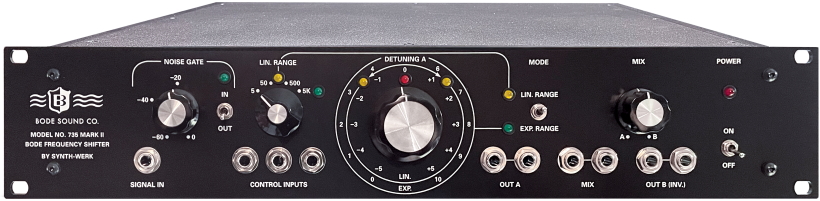
The model 735 Mark II is, like its predecessor, the model 735, a most sophisticated and powerful signal processor. In some of its typical applications it can change known sounds with a harmonic overtone structure into new sounds with an entirely different and new arrangement of overtones through additive and subtractive frequency shift. It thus contrasts with and complements the known pitch changers (such as the HARMONIZERTM), which operate with multiplicative frequency shift.
As a keyboard-controlled instrument (1 volt/octave), the 735 Mark II is capable of producing an infinite variety of bell, chime, carillon, wood block, marimba, steel drum and other sounds, maintaining the chosen timbres over the entire playing range. As a non-keyboard-controlled instrument, it is very useful as a new type of drum detuner, and generally suited for any quasi-pitched sounds. Especially interesting percussion effects may be produced with sequencer derived control voltages for the detuning and slaving of the sequencer clock through an envelope follower from the percussion tone source. Another interesting effect is the ”drumwhip“, which is produced by adding the output of an envelope follower (receiving the drum tone bursts) to the control voltage input of the frequency shifter.
Due to a revolutionary new design of its patented local oscillator (quadrature oscillator), facilitating frequency shifts down to a fraction of 1Hz (typically less than 0.05Hz), the model 735 Mark II can now be utilized for some very interesting ambience modulation effects. Furthermore, when inserted in the feedback loop of a delay line, the ”spiraling echo effect“ can be produced. This opens up an unexplored variety of musical applications.
Technically speaking, the model 735 Mark II is a one input/three output signal processor with three control voltage inputs. The signal input may receive any program material including that of a synthesizer V.C.O. At the output jacks OUT A the input signal appears detuned to one side, and at OUT B to the other side. At the MIX output jacks, a mixture of the OUT A and OUT B signals is obtained, which in the center position of the MIX control is that of a ring modulator.
The controls of this frequency shifter include a threshold control for the squelch circuit (NOISE GATE), which can silence the carrier in absence of a program signal or below a preset program threshold level. A range switch (below the heading LIN RANGE) facilitates the selection of the tuning ranges, which cover the ranges from +5Hz to -5Hz detuning through +5kHz to -5kHz detuning in the linear mode (selected by the MODE switch). With the MODE switch in the EXP position and the RANGE switch set to 5k, the instrument is keyboard compatible and the frequency shift changes by one octave for every volt of control voltage change.
When operating the instrument without an external control voltage, the main tuning knob provides an internal control voltage range from -5 volts to +5 volts DC. Which in the linear mode provides the frequency shifts selected by the RANGE switch, and which in the exponential mode provides frequency shifts in a total of 10 one octave increments. When operating the instrument with an external control voltage, the internal and external voltages are added and jointly affect the frequency shift.
When operating with a keyboard controller (EXP mode), the desired timbres (bells, chimes etc.) are pre-selected with the main tuning knob. When operating in the linear mode, good drum detuning effects can be achieved in the 500Hz and 5kHz tuning ranges. In this mode, the amount of detuning may be controlled manually with the main tuning knob or remotely, for instance by a control voltage pedaI. Due to the special circuitry used for the local oscillator, a minute pitch jump may be heard occasionally when going through zero detuning. This happens in the linear mode only and not in the exponential mode.
The nominal input signal level is +4dBm with a peak signal capability of +18dBm. The frequency response is 20Hz to 20kHz. The instrument has unity gain. The total unwanted distortion and modulation products are less than 1%. Hum and noise are better than 65dB below maximum signal level.
This instrument is only available from SYNTH-WERK and the first run will be produced in May 2026, after SUPERBOOTH.