 How to resolve AdBlock issue?
 Cranborne Audio Brick Lane 500
Modal Compressor based on Legendary Analog Technology
Author: Matthias Fuchs | Photos: Peter Kaminski
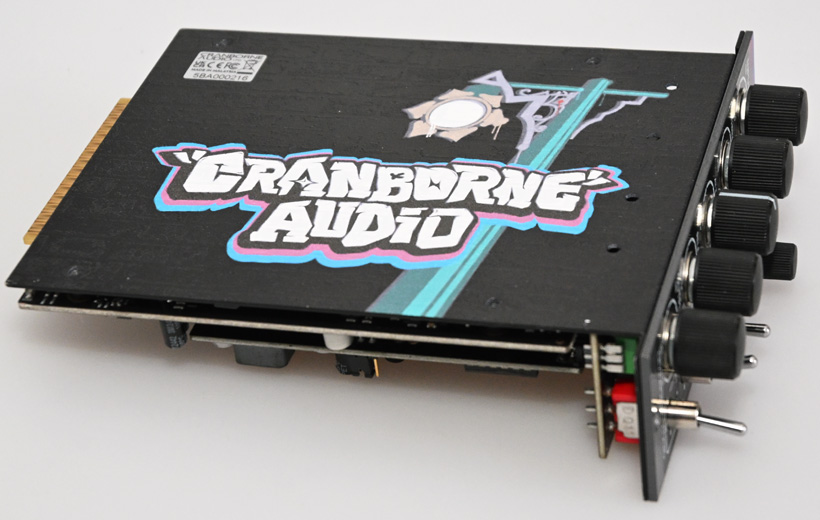
Does the analog audio world still have surprises in store? London-based manufacturer Cranborne Audio promises just that. With a background in legendary console manufacturer Soundcraft, the British company has set itself the goal of updating familiar concepts and transforming them for the modern studio environment. We take a closer look at Cranborne's latest creation - the Brick Lane 500 compressor module.
The successful product history of the past seven years proves that Cranborne Audio can certainly keep its bold promises. The Carnaby “harmonic EQ” combines an equalizer and an exciter in a truly successful and innovative way. Now Sean Karpowicz's team surprises us with the Brick Lane 500, a compressor/limiter in 500 format that, unsurprisingly, aims to reinvent the art of dynamics processing – at least a little bit...
Concept
Typical for a Cranborne Audio tool, the Brick Lane also combines several functional groups. In this case, it is a compressor/limiter followed by a multiband saturation stage. At first glance, this is anything but new or even unusual.
However, the term “PWM compression” used by the Brick Lane catches our attention. This is a technology that was first used for audio compression in the late 1960s. Instead of controlling the level in the usual way with a voltage controlled amplifier, the signal is switched on and off at a frequency of at least 250 kHz – in other words, converted into a high-frequency pulse wave. The detector circuit constantly determines the ratio between the two states “signal on” and “signal off”: the less of the signal is present, the lower the average output level - which means that compression becomes increasingly strong and vice versa.
The advantages of this technology include an unparalleled fast control response and extremely distortion-free results - even with strong compression. The disadvantage lies in the high demands on the precision of the PWM process and the need for complex anti-aliasing filters – reasons that have made the PWM compressor something of an exotic item. Cranborne Audio has now turned to modern digital technology to support the complex processes with the help of microcontrollers. The signal path remains completely in the analog world. The PWM process also provides the technical means for extremely fast and completely latency-free look-ahead switching, as well as very complex and versatile configuration options.
This compressor/limiter is also equipped with a saturation stage, which, along with six compression modes and the usual compressor parameters, allows for a wide range of influence on the signal.
Understandably, the manufacturer remains silent about the exact technical implementation. A look inside the 500 series module reveals plenty of state-of-the-art analog technology and an STM32 ARM Cortex microcontroller - the heart of the PWM control and compression modes.
Hardware
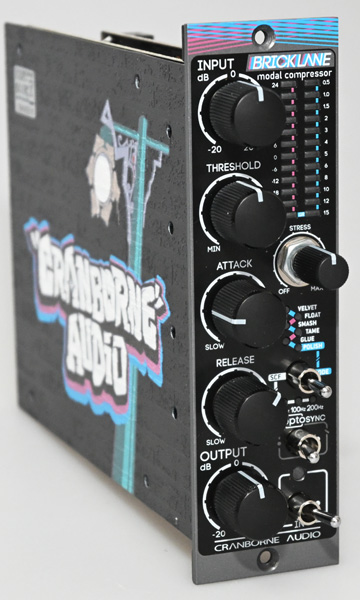
The Brick Lane Compressor's cassette has a heavy front panel and is equipped with neatly screwed-on controls. Five of the six potentiometers are lightly incremented with 40 steps, only the stress potentiometer is continuously variable. All knobs feel excellent. The three toggle switches/buttons also give no reason for complaint.
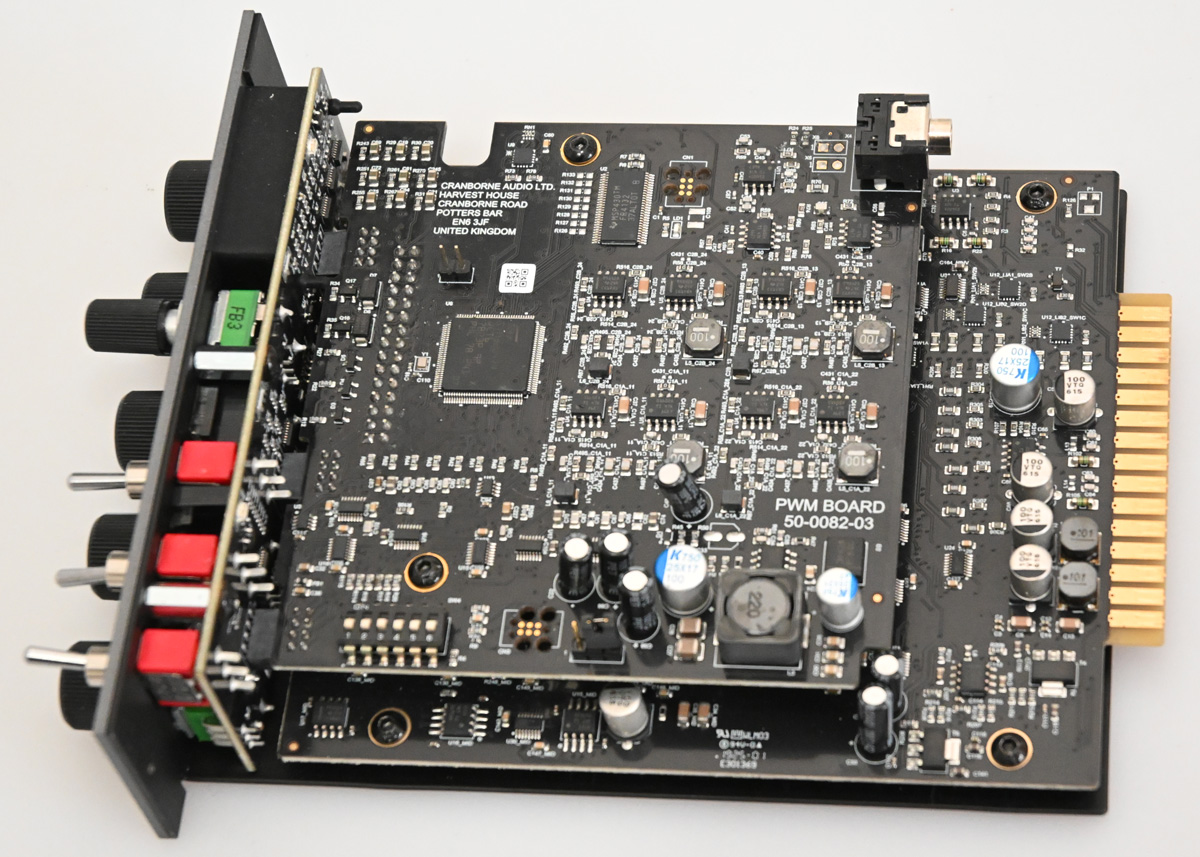
Overall, the construction makes an extremely solid and high-quality impression. Nevertheless, the densely packed front panel makes the operation very tedious. Some of the lettering is so small that older users, at least, should have their reading glasses handy.
Inside the device is a DIP switch strip that can be used to adjust several settings. In addition, the so-called Enigma mode can be activated here. It provides access to fourteen hidden parameters (including knee, ratio, sidechain behavior) that can be used to change the module's behavior over a wide range – very interesting, but due to the comparatively complicated operation, it is intended more for real specialists.
Controls
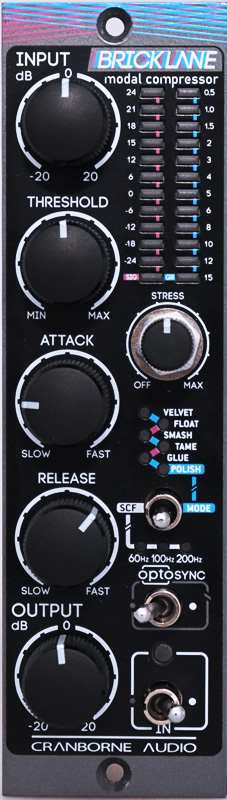
At first glance, the controls of the Brick Lane 500 look very familiar. On the left are the knobs for input, threshold, attack, release, and output. The labels and scales are well chosen. A toggle switch at the bottom right activates the compressor, while another activates the (opto) sync.
The upper switch is actually a button with a neutral center position. It responds to short and long taps to the right or left, cycling through the six compression modes, the four sidechain filter settings, and several stereo link modes. This is cleverly done, but also quite fiddly in handling.
The stress control determines the intensity of the saturation function. Two 12-step LED chains signal input and output levels, level reduction, and several other operating states, depending on the configuration.
In sync mode, multiple brick lanes can be linked. All knobs are then controlled by one module. The manufacturer came up with a very interesting technical implementation for this: values and data are transferred between neighboring modules via optoelectronic means, i.e., using LEDs and photodiodes.
If two modules are operated horizontally next to each other - as in our test setup - the “Optosync” can be replaced by a conventional cable. Detailed operating instructions for the module can be found on the manufacturer's website, and numerous tutorial videos are available on Cranborne Audio's YouTube channel.
In Practice
The Cranborne Audio Brick Lane 500 quickly reveals its capabilities. Initial tests with a drum sum spontaneously impressed with extremely crisp and powerful results. With the appropriate release time, the signal could be “shortened” very appropriately and precisely. The room was only slightly “raised.”
When working with sidechain filters and saturation (and thus with the “Stress” knob), the loudness increases significantly. The frequencies of the sidechain filter are excellently chosen and allow the compressor to be “captured” depending on the program.
In addition to carefully adjusting the control times, a suitable ratio between the input and threshold is important for achieving optimal results. A strongly boosted input allows the Brick Lane to work in a noticeable yet highly musical way. With a strongly boosted input, the finely adjustable saturation function also unfolds its full splendor: depending on the intensity and compression mode, it subtly compensates for any sterility and delivers a certain brilliance and, ultimately, additional loudness. The sound impression is not unlike a very subtle exciter effect. With the compressor almost inactive, the stress knob can audibly bring the vocals of a mix to the foreground or broaden certain sound components – always within the bounds of what makes sense sonically, of course.
Equally impressive is the performance and variety of the six compression modes. Each setting seems to be optimized for specific applications and program material. For example, “Tame” produces a nice fat but crisp bass, while “Smash” sounds very tight. “Glue” delivers an open sound that makes drums, in particular, appear more vivid. Vocals are exceptionally well served with “Velvet.” The same applies to “Float,” but it has an even more subtle effect. In all settings, the module works with a high degree of transparency.
While it is not always easy to adjust the time constants for flat sounds or Fender Rhodes played accordingly without slight pumping, the Brick Lane performs miracles, especially with basses: the control times suddenly fit perfectly, and the groove is supported in a highly musical way. The only downer: The input and output knobs produce a noticeable zipper noise, at least at high “stress” settings. Switching between compression modes is also accompanied by noticeable background noise. According to Sean Karpowicz, these phenomena are the result of the extremely complex circuit topology of a 500 series module and are therefore, unfortunately, not entirely avoidable.
Conclusion
The Cranborne Audio Brick Lane 500 is available for just under €850. As can be seen from the preceding lines, the Cranborne Audio Brick Lane Modal Compressor impressed the tester to the highest degree. It is not just another compressor limiter with remarkable audio qualities – the Brick Lane is an extremely versatile and adaptable dynamics tool of the highest quality. Its range extends from subtle exciter-like behavior to its use as a highly effective compressor for boosting volume.
The device does not make it easy for you at first. The Brick Lane neither embellishes nor forgives suboptimal settings. The Brick Lane is, therefore, definitely not a “set-and-forget” device. Perfect results require a great deal of intuition and familiarity. It needs to be precisely adjusted for each piece of audio material. Once you have become familiar with the device and developed the necessary intuition, the Cranborne Audio Brick Lane 500 rewards you with consistently great results that are second to none. This makes it a real asset for demanding recording and mixing tasks.