 How to resolve AdBlock issue?
 Sennheiser MKE400
Camera Microphone with Supercardioid Polar Pattern
Author and photos: Peter Kaminski
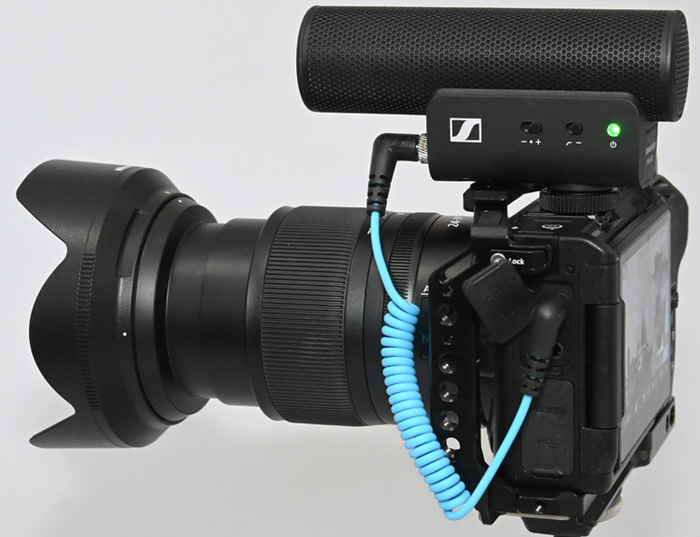
The Sennheiser MKE 400 is available since 2021. We have also tested the more compact Sennheiser MKE 200 - but since compact cameras such as the Nikon ZR are increasingly being used in the professional sector, offering excellent performance in the video sector, they only have basic functions in the audio sector, which makes special audio interfaces or supplementary microphones very interesting. The MKE 400 is available as a single product, as well as in a so-called “MKE 400 Mobile Kit” for use with mobile phones.
Scope of Delivery
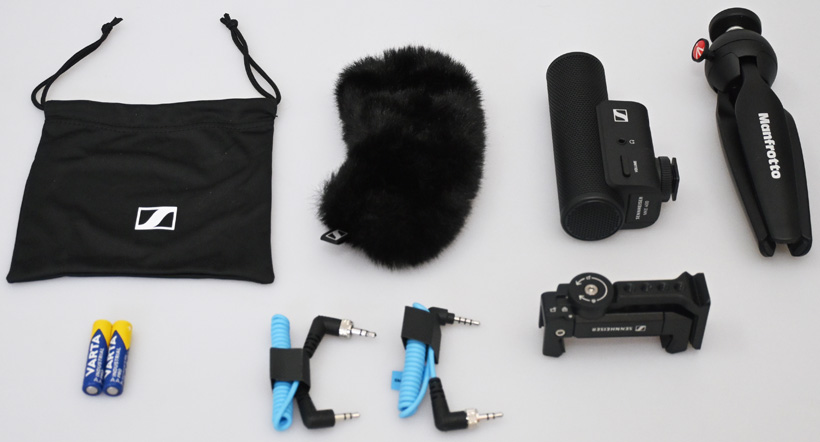
First, an overview of the scope of delivery of the Sennheiser MKE 400 Mobile Kit. In addition to the microphone, fur windshield, carrying pouch, two cables, and two AAA batteries, the kit also includes a PIXI mini tripod from Manfrotto (height 135mm) with tilt function and a very sturdy metal clamp for attaching a mobile phone. Both spiral connection cables have a stereo mini jack plug that can be locked to the microphone and a stereo mini jack socket for connection to cameras, as well as a TRRS socket for use with mobile phones on the other side.
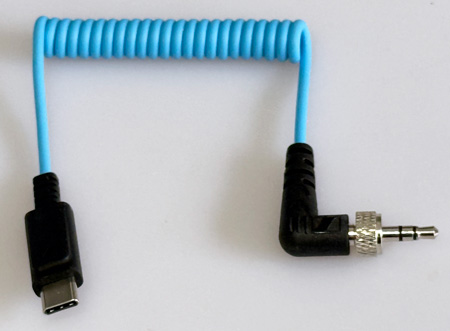
Not included in the scope of delivery but available as an option, Sennheiser offers the CL 35 USB-C cable (product code 509262), which can be used with the Apple iPhone, for example, and also has a lockable plug on the microphone side.
Technical Specifications
The MEK 400 is a compact (126 x 67 x 37 mm, weight 94 g) electret microphone with prepolarization. Sennheiser specifies the frequency range to be between 50Hz to 20kHz. It offers a supercardioid polar pattern, a sensitivity of -23, -42, or -63dBV/Pa, depending on the gain setting, and can handle a maximum sound pressure level of 132dB SPL. Power is supplied by two AAA batteries, which provide over 100 hours of operation. The built-in headphone amplifier offers 105mW output power on headphones with 16 ohms impedance, or 70mW on 32 ohms. At 50 mW, the THD value is less than 1%.
Operation
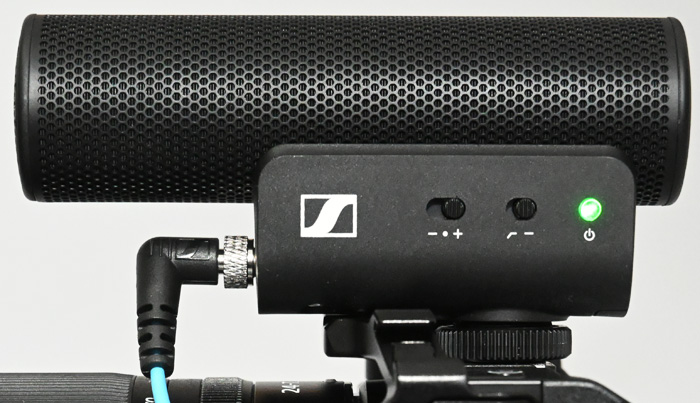
Operation is relatively simple. There is a button for switching the device on and off, a switch for the gain (-20, 0, or +20dB), and a switchable high-pass filter (-6dB at approx. 180Hz). The cable for the audio connection to the camera is connected and locked in place at the front.
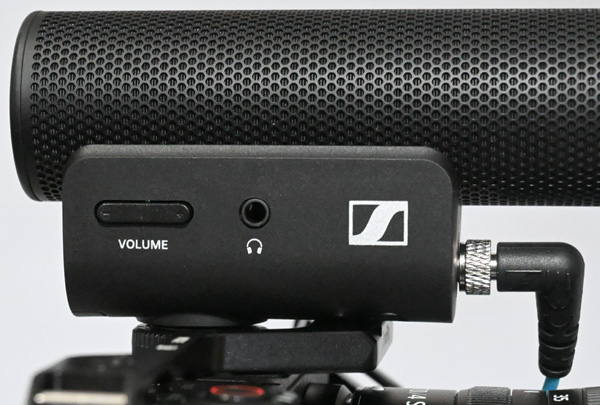
On the other side of the lower plastic housing is the headphone jack, with the option of adjusting the level via a rocker switch (eight 6dB steps).
In Practice
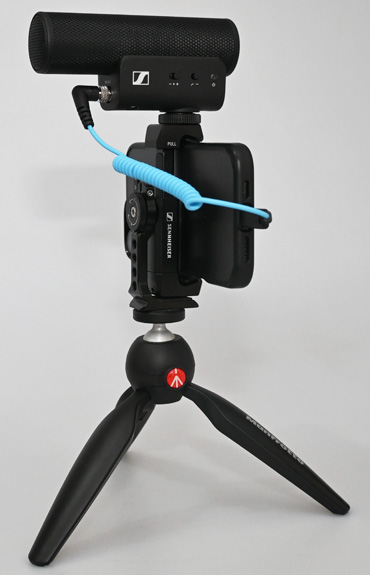
The Mobile Kit is really very practical. The clamp for the mobile phone has both a 1/4“ and 3/8” thread and can even be attached to an Acra Swiss-compatible tripod. The orientation of the mobile phone can be changed from horizontal, as shown in the picture, to vertical. The clamp is large enough to easily attach Apple Pro Max iPhones.
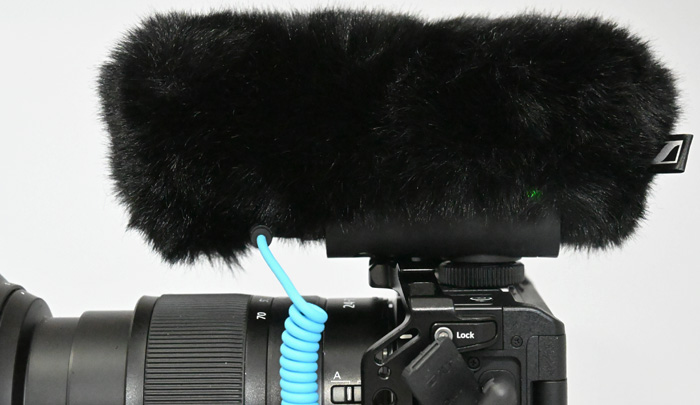
The included windshield is open at the bottom and can be easily slipped on. Now to the sound quality. We conducted the primary sound test with a Nikon ZR and compared it with the internal microphone. With the Nikon ZR, you can set the preferred recording direction, i.e., no directionality, either rearward or forward. We made recordings at a distance of one and 2.5 meters in a room without acoustic damping, using the internal microphone with directionality to the front, the MKE 200, and the MKE 400.
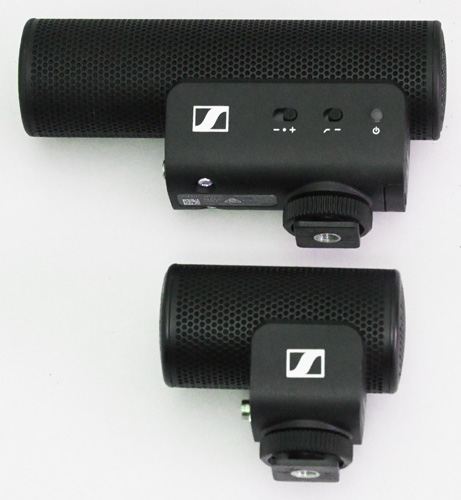
At a distance of one meter, the internal microphone is still perfectly usable, but even the very compact MKE 200 picks up less room reverberation. With the MKE 400, only a very small amount of room reverberation was noticeable. At a distance of 2.5 meters, I would no longer use the internal microphone from a professional point of view - because the room component is very noticeable, and, especially in interview situations, the speech intelligibility suffers as a result. The MKE 200 is still acceptable here, and with the MKE 400, the room sound is significantly reduced with good speech intelligibility. Above all, the sound is also impressive from a distance. The MKE 200 cuts off more in the lower frequency range than the MKE 400, which still offers a nice and balanced bass response. The -6dB frequency (related to 0dB @ 1kHz) is at the lower end at around 80Hz.
The MKE 400 is twice as long as the MKE 200 but still very compact compared to other shotgun microphones. Even if you only want to record a synchronous sound for editing or listen to what is being said, the MKE 400 is very helpful. At a trade fair booth with a lot of ambient noise, it is often impossible to understand what the presenter is saying from the camera’s location. If you don't use a wireless connection and record the speaker directly with a small recorder, you no longer have the option of checking the spoken word at the camera. However, using the MKE 400 significantly improves this situation. That's why I always use it, even when I'm recording the sound on another recorder.
The only point we further need to mention is that when transporting the microphone in a bag or camera case, it is activated by a slight pressure on the power button, so I have gotten into the habit of removing the batteries for transport on the way to the shooting location. A mechanical switch would probably have been the better option here.
On a positive note, when the microphone power supply is activated in the camera, the MKE 400 automatically switches on and off depending on the camera’s status.
Conclusion
The price for the MKE 400 is just under 200 euros, and for the Mobile Kit it is under 230 euros. This makes the Mobile Kit particularly good value for money, as for a small additional charge, you get the table tripod and the high-quality mobile phone holder.
Despite its directionality, the MKE 400 is still a very compact microphone with impressive sound quality. Thanks to its hot shoe mount and headphone amplifier, it is ideal for significantly optimizing the audio quality of compact video cameras. The only further improvement would be a special audio interface that offers phantom power and significantly longer shotgun microphones.