 How to resolve AdBlock issue?
 Shure KSM44MP, KSM40C and KSM32C
Author and photos: Nick Mavridis
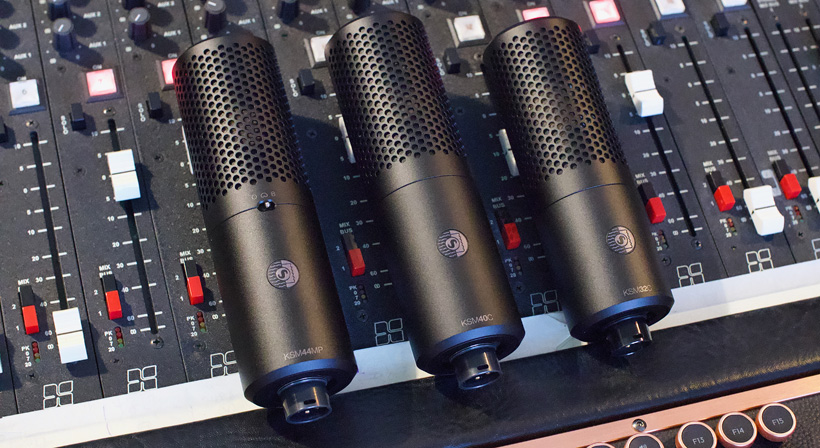
Anyone involved in audio engineering is familiar with Shure microphones. However, most people will first think of the iconic SM57, SM58, and SM7B models - all of which feature moving-coil transducers. Since acquiring Crowley & Tripp, the manufacturer has also been offering microphones based on the another dynamic principle: ribbon microphones. Condenser microphones also play a major role in Shure’s portfolio, including the excellent handheld KSM9 and the mechanically switchable KSM141.
Technology of the Three Microphones
My previous opinion on Shure large-diaphragm microphones: technically and sonically top-notch, but visually definitely not something you’d want to look at. That has changed, as the Shure KSM44MP, KSM40C, and KSM32C now feature a more industrial look that reminds me of early Groove-Tubes microphones and some Baltic models. The black tubes are connected to a mount or shock mount via a threaded connection, with the XLR jack for the microphone cable located in the center.
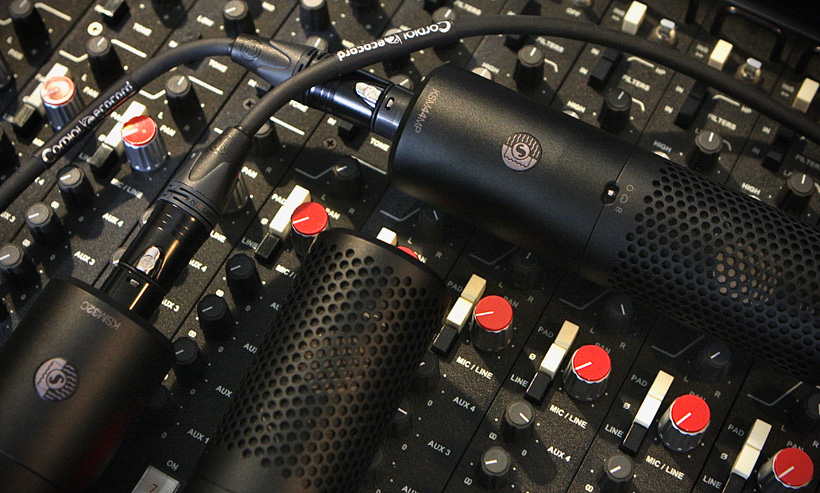
Mit seinen drei wählbaren Richtcharakteristiken Kugel, Niere und Acht, der randkontaktierten 1-Zoll-Kapsel führt das Shure KSM44MP die neue Serie an, das mit elastischer Halterung und Pop-Schutz ausgeliefert wird.
For those who are certain they only want to use a large-diaphragm capsule with a cardioid polar pattern, the KSM40C offers a non-switchable version. Both models feature a switchable high-pass filter (at 80Hz with a filter slope of 18dB/octave) for rumble filtering, and a roll-off (single-pole filter at 115Hz) to reduce bass boost at close range, as well as a 15dB pad option.
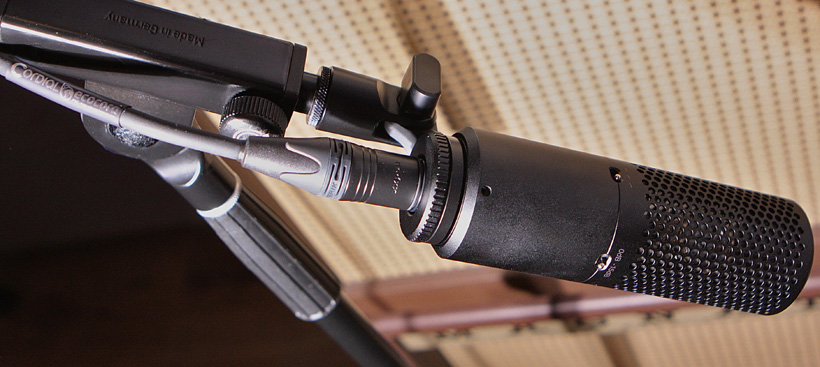
Some users would describe the Shure KSM32C as a mid-diaphragm microphone rather than a large-diaphragm microphone, as its diaphragm diameter is 3/4 inch - the same as that of the Neumann K89, U89, TLM127, and TLM170R microphones. The KSM32C can be recognized by its shorter body compared to the 40 and 44 models. To dispel any false suspicions: Shure manufactures these microphones in Mexico, not in China.
Technical Specifications
The included multilingual manuals indicate that the technical specifications make a highly professional impression. In particular, the KSM44MP’s self-noise of just 5dB (A-weighted) in cardioid mode stands out.
Even before applying the pads, the maximum sound pressure levels for all models exceed 130dB SPL. However, Shure defines this limit not at 0.5 percent, but at 1 percent THD+N. Nevertheless, these are respectable figures. No surprises are to be expected with weaker preamps, as the gain factors and impedances of all three microphones are state-of-the-art.
The graphical frequency response curves are typical for modern studio microphones: slight treble boosts with a gentle roll-off at 20kHz, and slight reductions in sharpness with the two larger microphones. The two switchable polar patterns of the KSM44MP differ from the cardioid: the omnidirectional pattern has its peak at 10kHz, slightly higher than the cardioid, while the figure-8 pattern is significantly more pronounced, with a boost at 5kHz to 6kHz. Speaking of polar patterns: All diagrams show typical characteristics. The KSM32C’s tendency toward a figure-8 pattern in the high frequencies and an omnidirectional pattern in the low frequencies is less pronounced due to its smaller design.
Build Quality and Handling
The design of the three new KSM studio microphones offers a much better balance than their predecessors did. If you find it a bit too bulky, you should consider other Shure microphones, especially the SM7B. In that respect, the design language is already much more consistent. Even with the worst of intentions, I can’t detect any North American carelessness in manufacturing or questionable material choices. My three test microphones are all well-built and feel high-quality.
Sound
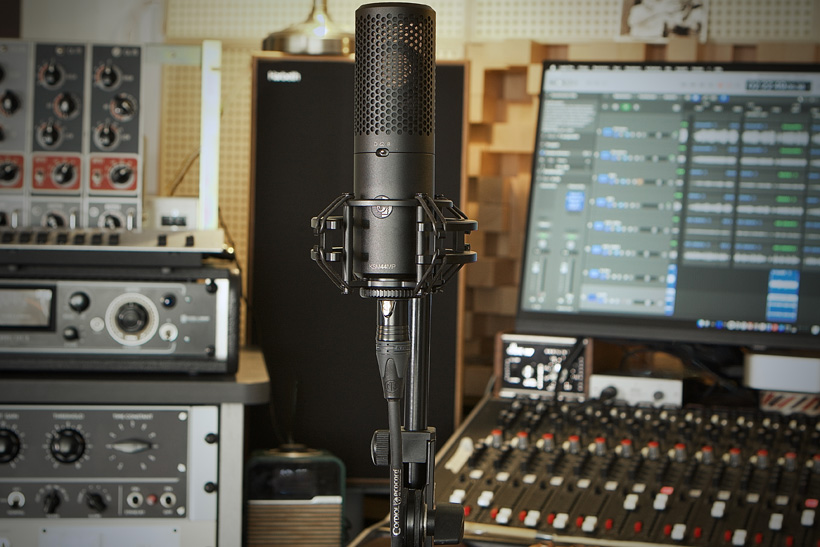
The Shure KSM44MP, KSM40C, and KSM32C all stand out for their very accurate and detailed sound. This makes them an absolutely high-quality foundation for any type of recording. The lows are beautifully controlled, the highs are clear but not glassy, and the mids have a solid, well-defined sound. All of these are indications of high-quality components, a short signal path, and, above all, good tuning of the components to one another. Depending on the choice of preamp, I already have a range of options in the studio to slightly shape the sound in a desired direction; I don’t have any favorite combinations.
It’s striking that the on-axis side lobes are very pronounced. This applies explicitly to the omnidirectional and figure-8 characteristics combined from the two cardioid sides of the Shure KSM44MP. I could also easily imagine using a stereo pair to mic ensembles. However, as overheads on a drum kit and in a two-channel setup for an acoustic guitar, the 40C and 44MP left me very satisfied. Sonically, however, I found the Shure KSM32C to be a better fit; it had a bit more bite and didn’t exhibit that slight broadening in the high-frequency range characteristic of many large-diaphragm microphones that are slightly rolled off in the treble. Compared to the Conneaught Equitek E200, which features similar capsule dimensions, the Shure proved to be significantly more neutral, wider in frequency response, and less gritty. Hardly any microphone of this design can match the resolution, transparency, and responsiveness of the Sonodore MPM-91 mkI, which is based on the Neumann K89 capsule - though we’re talking about a completely different price range here.
When it comes to sung and spoken vocals, the two closely related KSMs - the KSM44MP and the KSM40C - likely find their favorite acoustic signal source. Sharp consonants don’t become too piercing, yet the signal doesn’t blur either, thus preserving the generally very high speech intelligibility and clarity. At close range, there are microphones that are better at handling plosive sounds, though this often comes at the expense of the high frequencies. However, you’ll want to position the microphone close to the source, as the bass boost from the proximity effect is crisp and easy to control, with little risk of boomy sound.
Conclusion
The Shure KSM30C, with its smaller diaphragm, is available for approximately 730 euros without a shock mount and approximately 800 euros with a shock mount. The cardioid microphone KSM40C costs 970 euros, and the Shure KSM44MP, with its switchable polar pattern, costs 1209 euros. All three microphones are all-rounders, offering high quality at an absolutely fair price. Shure is wise not to offer “mix-ready” signals from the microphones, but rather to give users the freedom to shape the sound path as they see fit.