 How to resolve AdBlock issue?
Teufel STUDIO 5X
Studio Monitors with a Coaxial 3-Way-System
Author and photos: Christian Kalinowski
Whereas in years past there was a sharp divide between dramatically enhanced hi-fi sound on one hand and neutral, analytical studio monitoring on the other, the acoustic perspectives of these two camps have surprisingly converged in recent years. Home entertainment enthusiasts have long been equipping their living rooms with absorbers and corner traps for an optimal listening experience, achieving room acoustics that are the envy of many home studio tinkerers. At the same time, more and more production work and content creation is taking place in rooms and on monitoring setups that aren’t necessarily designed as studios. The lines between home audio and professional production are thus becoming increasingly blurred.
Against this backdrop, it’s a perfectly logical development that an established hi-fi manufacturer like Teufel is now taking the plunge to launch a dedicated studio monitor. For one thing, the boom in home studios and content creation demands listening tools that sound precise but aren’t prohibitively expensive - precisely the terrain where direct-to-consumer retailers like Teufel have held a home-field advantage in terms of pricing for decades. For another, the development of good speakers - whether for the studio or the living room - is based on the same physical laws (and limitations). And driver and amplifier technology, enclosure acoustics, and digital signal processing (DSP) are, of course, part of the Berlin-based company’s core repertoire.
So when Teufel brings its expertise in dynamics, signal handling, and value for money to bear in building a studio monitor, it’s not an experiment - it’s a statement. Our review will determine whether the speaker masters the fine line between neutral studio precision and the typical Berlin-style enthusiasm for sound.
Concept
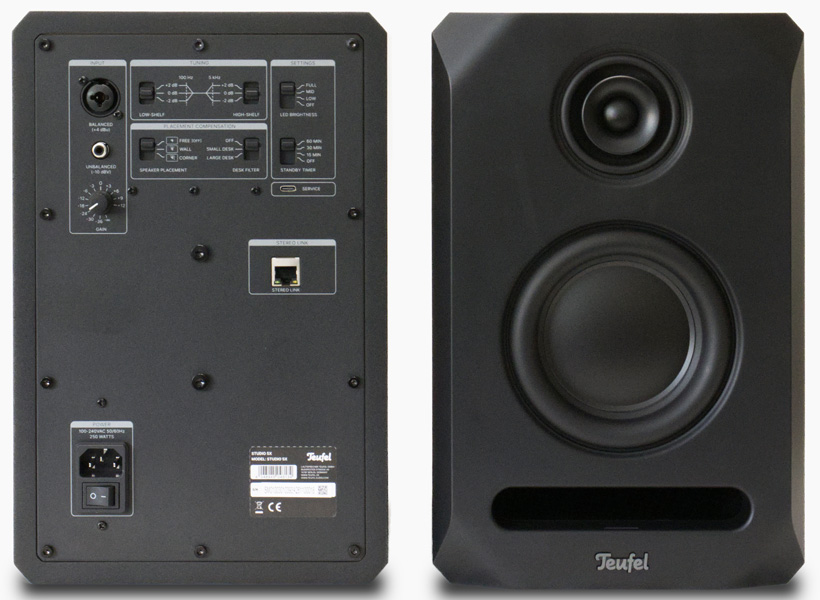
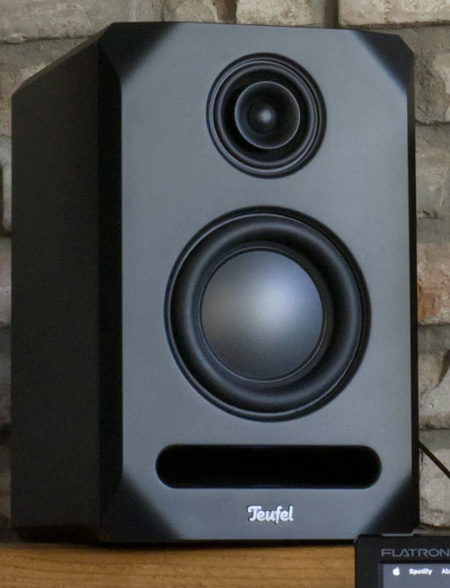
The Studio 5X is a concentric-coaxial 3-way system. In this context, “concentric-coaxial” means that the 20-millimeter high frequency driver is positioned exactly at the center of the 75-millimeter midrange driver. This is a proven technique for ensuring optimal time-alignment and localization coherence between the two speakers, though it does pose a certain challenge in terms of design. Here, of course, Teufel can draw on its own in-house developments, as a coaxial design is already used in the widely acclaimed Stereo M2 bookshelf speaker.
Another advantage of the coaxial arrangement: since the time-of-flight differences are negligible and the integrated waveguide has no specific orientation but instead radiates uniformly, the speakers can be positioned vertically or horizontally. To further optimize the dispersion characteristics, the edges of the front panel have been slightly beveled all around - speaking of diffractions.
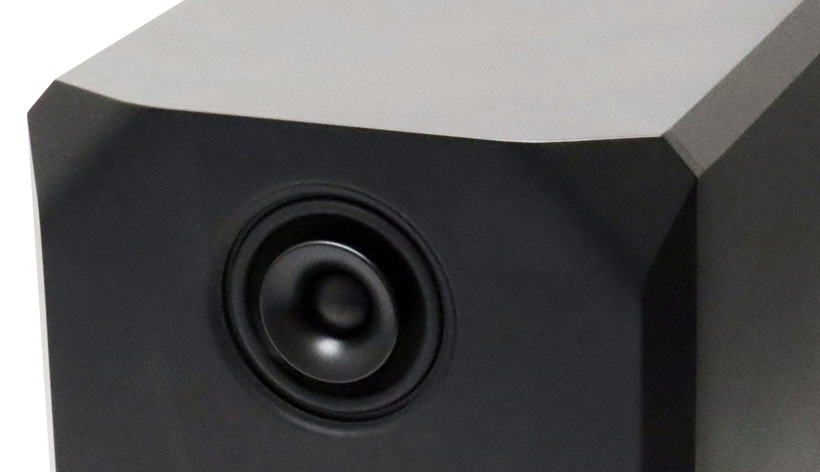
Low-frequency reproduction is handled by a 5.2-inch driver. In doing so, however, Teufel has taken on the trickiest challenge in monitor design, because the rule is: larger designs deliver more frequency material for a balanced frequency range simply due to the larger driver, and the larger enclosure offers more space for optimizing the bass-reflex path. With a 5-inch driver, the situation is correspondingly more complicated. Here, the challenge is to achieve an optimal balance given the available space and speaker power.
On top of that, the Studio 5X are active monitors, which means their three-channel amplifier also had to be housed invisibly within the enclosure. With a height of 32.8 centimeters (width 21.3cm, depth 26cm) and a weight of eight kilograms, this makes for a rather bulky design for a 5-inch model.
Amplifier
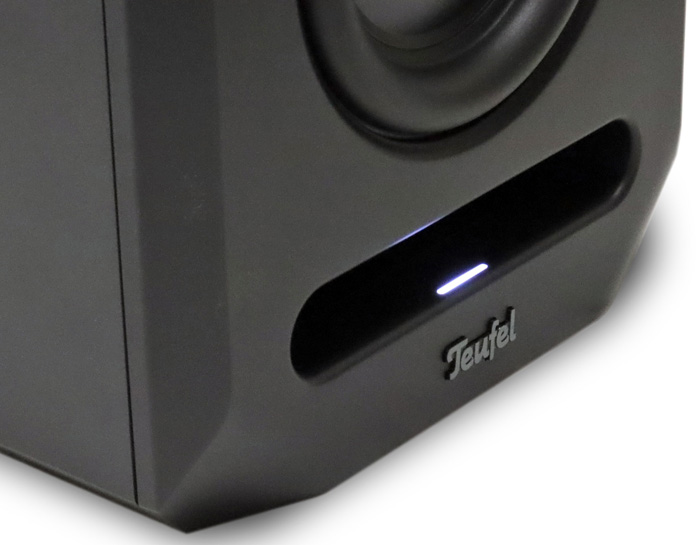
The amp converts the maximum input power of 250 watts into a total output power of 122 watts RMS. To reduce electricity costs when not in use, the monitors feature a standby circuit that can either keep the amplifier off entirely or put it into sleep mode after 15, 30, or 60 minutes, at which point the power consumption drops to just 0.5 watts, according to the manufacturer. In our test, this value was significantly higher at 3 watts; however, the power consumption at 86 decibels (measured at a distance of 1 meter) was a modest 11 watts. During all power-on and power-off sequences, the speakers are connected with a delay, which effectively prevents startup crackling. After powering on, the LED on the bass reflex port briefly glows red and then switches to a steady white light, the brightness of which can be adjusted or turned off entirely.
A version with a built-in Bluetooth receiver is also available under the name Studio 5X BT. König & Meyer also offers a height-adjustable tabletop stand as part of its accessory lineup. All Studio 5X units come with standard foam pads and a power cable (2 meters long). On the rear of each loudspeaker, there are two M6 threaded mounts for installation on stands, wall mounts, or ceiling mounts.
Operation
All controls and connection ports are located on the rear of the speakers. In addition to the power jack and toggle switch, the input section and audio inputs are located at the top left: options include standard jack, XLR (both balanced), or RCA jacks (unbalanced), as well as a gain knob (from minus infinity to +12 decibels). The input jacks are configured in parallel. Theoretically, therefore, multiple signal sources can be connected to the various jacks.
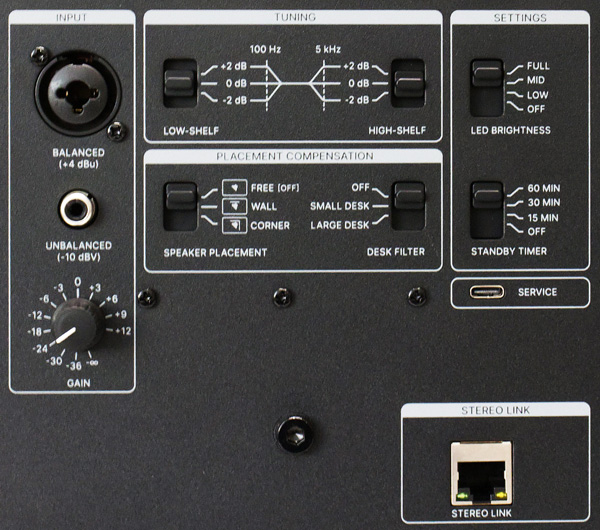
To the right of these are four toggle switches, each with three possible positions, which control the built-in equalizer for sound adjustment. The top unit is labeled “Tuning.” Here, the bass frequencies below 100 hertz can be boosted or cut by two decibels. The same applies to the high-shelf filter located to its right, whose cutoff frequency starts at 5 kHz. Below that is the “Placement Compensation” section, which adjusts the equalizer according to the speaker’s placement (freestanding, against a wall, in a corner) and the size of the desk (if present) (none, small, large). On the right edge is a toggle switch for adjusting the LED brightness on the bass reflex port (full, medium, low, off) and for presetting the standby mode duration (60, 30, 15 minutes, off).
There’s also a USB-C port for potential firmware updates and a network port, though the latter is only relevant if you want to pair a Studio 5X BT for stereo operation.
Sound
Of course, the author himself enjoys reading reviews frequently and regularly takes issue with the overused phrase “one inevitably wonders where the subwoofer is.” But in the case of the Studio 5X, it’s hard to avoid this overused cliché, because these compact speakers actually fill a 18-square-meter control room with a level of bass energy that, even with the best will in the world, you wouldn’t expect from such small 5-inch drivers. For comparison, I had access to the permanently installed combination of Neumann KH310s and a 750 subwoofer, and I can report that the soundstage did not collapse in the slightest when switching to the Studio 5X - despite a total diaphragm area that is less than half as large.
This performance is due, on the one hand, to the very long excursion of the bass driver (an in-house development by Teufel) and, on the other hand, of course, to the bass-reflex design, at whose front port we could not perceive any airflow noise and which extends the bass foundation all the way down to around 40 hertz. However, this comes with a level loss of around 10 decibels - somewhere, the limits of physics are reached.
The Studio 5X cannot entirely eliminate the only inherent problem with all bass-reflex speakers (as opposed to enclosed speakers), namely the resonance signature of the bass-reflex design itself. Without getting too deep into the physics here (keyword: Helmholtz resonator), every bass-reflex speaker has a specific (and desired) resonance frequency in the bass range at which a slight boost occurs, followed by an attenuation below that frequency. In the case of the Studio 5X, I was able to identify the range around 100 Hz as the cutoff frequency. Both the “pro” and “con” camps regarding the sound of bass-reflex speakers have compelling arguments in favor of their respective speaker designs, which is why I mention this fact solely for the sake of technical completeness and without offering any judgment.
Now for the mids and highs: Here, you can wholeheartedly believe the marketing claims regarding the finest resolution and precise localization, because the Studio 5X’s performance has completely won me over - I’d even say it has thrilled me, as the entire stereo image was reproduced with extreme precision at the listening position. This allows the speakers to achieve exactly the level of detail that any audio professional could wish for: ensuring that no detail is lost, so that you can make controlled adjustments to the final mix. Especially when it comes to the precision and vividness of transient reproduction, the successful interplay of high-quality drivers, an acoustically optimized enclosure design, a concentric-coaxial arrangement, and - last but not least - phase-stable FIR DSP equalization pays off in full, as everything is reproduced with extreme clarity. This is precisely what provides the necessary acoustic control needed during production to decide, for example, whether a compressor with a 10- or 20-millisecond response time should be applied.
Let me put it bluntly: If, after spending the necessary time breaking in the Studio 5X in an acoustically balanced control room, you still can’t manage to deliver a sonically flawless production, you won’t be able to do so even with monitors that cost twice or three times as much - and you’d be better off investing in the acoustics of your workspace instead.
Interestingly, at no point during the entire test did I feel the need or desire to use the built-in DSP sound adjustment. Of course, this is also partly a matter of taste: some people prefer a bit more bass, others a bit more or less treble - and it also depends on the room acoustics and speaker placement. Personally, I found the Studio 5X to sound just right and well-balanced from the very first moment.
Conclusion
Congratulations to Berlin, because the Teufel Studio 5X marks a flawless debut in the studio segment. These high-quality speakers deliver an impressively nuanced, neutral, and powerful soundstage that, thanks to the effective bass-reflex and speaker design, has enough low-end foundation to fully fill small control rooms as primary monitoring speakers. And with their clever concentric-coaxial arrangement, the Studio 5X provide audio professionals with exactly the density of sonic information needed to make targeted and confident production decisions.
Considering the performance offered and the market landscape, the listed price of 500 euros per pair - or 550 euros for the Bluetooth version - is absolutely reasonable.