 How to resolve AdBlock issue?
 Sennheiser Spectera for Sam Ryder
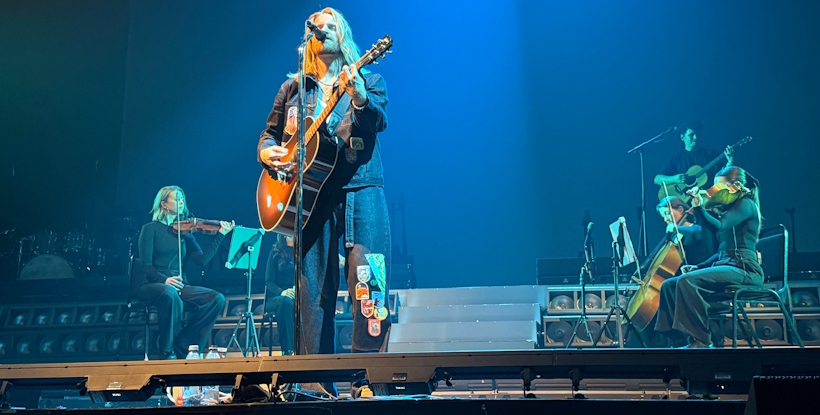
Picture: Jenny Hodge
When British singer-songwriter Sam Ryder embarked on his Road to Wembley tour in October 2025, the journey took him from the intimate corners of small clubs to the iconic expanse of Wembley Arena – a lifelong dream fulfilled. For monitor engineer Jamie Hickey, the tour presented a unique opportunity to test Sennheiser’s Spectera wideband wireless ecosystem in the most demanding and diverse environments imaginable. The result? A resounding validation of the system’s versatility, reliability, and sonic excellence across every venue on the tour.
Jamie Hickey, one half of the duo behind Production & Touring Ltd, brought 20 years of monitor engineering experience to his first tour with Sam Ryder. “It’s something I’ve always loved,” says Hickey of his job. “The thing I really enjoy is the challenge of getting into somebody’s head space and trying to understand what they want. Hickey’s business partner, Mike Taylor, who served as Production Manager, led the charge to have Spectera go out on the Road to Wembley tour.
As a long-time Sennheiser user with experience on the 2000 series IEM and evolution G4 wireless systems, Hickey had been eagerly anticipating the arrival of Spectera. “It was a natural progression to move to Spectera as soon as it was available,” he explains. “I arranged with Peter Craig [Sennheiser Relations Management] to be part of the Spectera Pioneer Program and get it out there and start using it. Not just in the obvious settings - the big arena shows - but to find out what it’s like under the spotlights of a small venue. And this Sam Ryder tour was an ideal scenario for that, because it culminated in a show at Wembley. But the run up to it was lots of small little gigs, 300 capacity venues, and we had all the same equipment for those shows that we had for the arena show.”
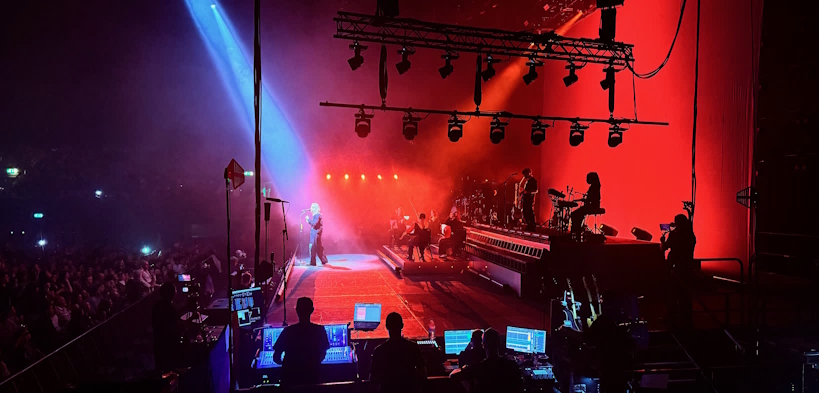
For Hickey, the technical advantages of the system were clear from the start. “The first thing you notice when using Spectera is the complete lack of background hiss; the traditional noise floor is a thing of the past,” he explains. “As soon as you start passing audio through the system, you can’t help but be impressed by the frequency response and stereo image. There’s so much space. Reverbs, keyboards, stereo guitar patches all come alive in a way that was previously impossible in live monitoring. It’s true stereo in IEMs for the first time, and it sounds really, really good.”
In total one Spectera Base Station, four DAD antennas operating on two 8 MHz TV channels, and 18 SEK bodypacks were deployed for the tour - a compact setup that would prove remarkably powerful across wildly different performance spaces. The system was complemented by a range of Sennheiser microphones including SKM 6000 handheld transmitters, MD 421 Kompakts, e 904s, e 935s, and MKH 416s.
Smaller venues present unique challenges that often go unnoticed in purpose-built modern facilities. “There isn’t necessarily a wing at stage left for you to put your monitor desk and all your equipment,” Hickey explains. “You have to poke things around corners, and get under archways and brickwork, and old infrastructure. I love the idea of us having this technology that is so powerful, so reliable, and sounds so good. And it doesn’t necessarily all have to be the big flagship events, which it obviously does incredibly well, too.” This philosophy - testing Spectera in the trenches of working venues rather than just showcase environments - provided invaluable real-world validation of the system’s capabilities.
Spectera’s bidirectional capability - the ability for each SEK bodypack to handle both microphone transmission and in-ear monitor reception simultaneously - proved transformative for the production. “This is a game changer,” says Hickey. “We have one ecosystem that is mics and in-ears. It’s one unit. That’s crazy. And the latency is so usable. The flexibility to be able to go from 0.7 up to 2.7, and to deploy your DSP, your available RF spectrum…It’s just wild.”
This flexibility was put to the test during a particularly meaningful moment at Wembley when Kelvin Pratt, Sam Ryder’s childhood guitar teacher, joined Ryder on stage to play a guitar solo on the song ‘Go Steady’. Pratt’s bodypack was set to transceive, with his guitar signal going to the line system via Dante, then amped through Pratt’s Kemper Profiling Amp, before going back out to the line system, all using Spectera’s ultra-low latency mode. Hickey admits he was initially concerned about the number of paths that signal had to travel through. “It was not a problem. Not an issue at all,” he confirms. “A complete game-changer. The Dante implementation is fantastic, and it’s a really good addition to the I/O side of it.”
Looking back on the tour, Hickey’s enthusiasm for Spectera is unequivocal. “We had absolutely no problem putting it through its paces, working either on a single RF channel or two RF channels. We’ve used it with Dante, we’ve used it with MADI. And it can only get better, based on all the conversations that we’ve had at Decibel Dialogues. There’s so much work going on behind the scenes, and I can’t wait to use it more on everything. It really is, in the most sincere sense of the word, a total revolution.”