 How to resolve AdBlock issue?
VSL Vienna Performer
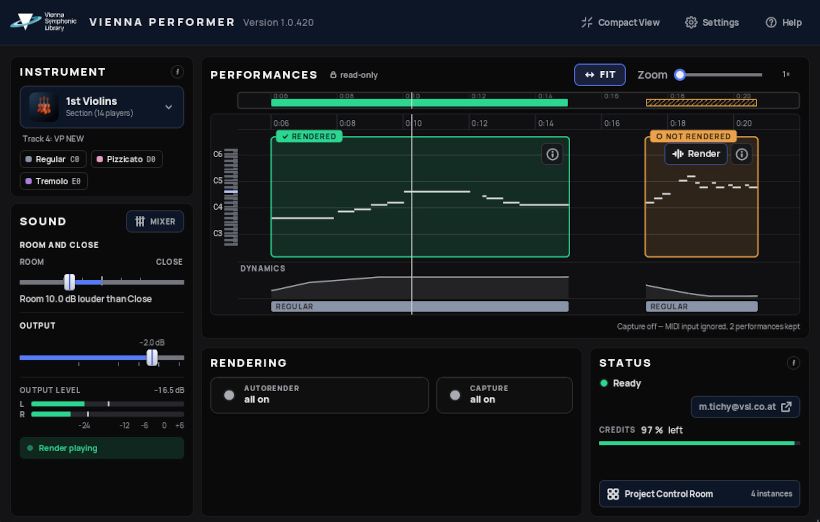
Vienna Symphonic Library has released Vienna Performer, a plug-in that takes the notes a composer has written and returns them as a performance. The parts are written as usual in a DAW or notation program; Vienna Performer renders them and places the audio back on the track. The AI models behind Vienna Performer were trained exclusively on recordings Vienna Symphonic Library made for the purpose, in sessions with musicians of the Vienna Synchron Orchestra at the company’s own Vienna Synchron Stage.
Vienna Performer does not compose. It has no prompt and no generative function: the musical substance – the notes, the dynamics, the phrasing – comes entirely from the user. What comes from the models is the performance: the articulations, the transitions between notes, the small timing that makes a line sound played rather than entered, and the acoustic character of the hall the recordings were made in.
It asks very little to do it. Note lengths, velocities, a single CC lane for dynamics and a handful of articulation switches are all a composer provides; from that, Vienna Performer plays the part the way a soloist or an ensemble would read it on a scoring stage. Ensembles are recorded as ensembles, not stacked from solo instruments.
Vienna Performer launches with the solo instruments Violin, Cello, Flute, Clarinet and French Horn, and with ensembles of 1st Violins, 2nd Violins, Violas and Cellos. Solo Trumpet and a Double Bass ensemble follow shortly, and new instruments are included in every plan as they arrive. Vienna Synchron Stage is the origin of every VSL Synchron sample library and of hundreds of film and game scores. Vienna Performer was recorded in the same hall, with the same players, so a render and a Synchron library are already matched when they meet in a composer’s template. Dedicated Synchron Player presets are provided for every instrument in Vienna Performer, so there is nothing to set up.
Renders may be used commercially without restriction and without further fees, and that license continues after a subscription ends. The material submitted and the rendered audio are deleted from the Vienna Performer service after the audio is returned; neither is used to train any model, and Vienna Symphonic Library acquires no rights in the music a user submits.
Vienna Performer is available now as a subscription, in three plans. Entry costs €9.99 a month and includes 140 render minutes; Standard is €19.99 for 360 render minutes; and Pro is €49.99 for 1,000. Each plan is also available yearly at ten times the monthly price – €99.90, €199.90 and €499.90 – so a yearly subscription gives two months free. Render minutes are allotted monthly in every plan, yearly subscriptions included. Render minutes are counted per instrument track, which is the figure to work from: a two-minute cue across twelve parts uses twenty-four render minutes. Additional minutes can be bought at any time in €50 steps.
The plug-in runs on macOS and Windows in VST, VST3, AU and AAX formats. It requires a Vienna Symphonic Library account and an internet connection; there is no standalone version and no offline rendering.