 How to resolve AdBlock issue?
Steve Stout relies on Focusrite’s ISA C8X
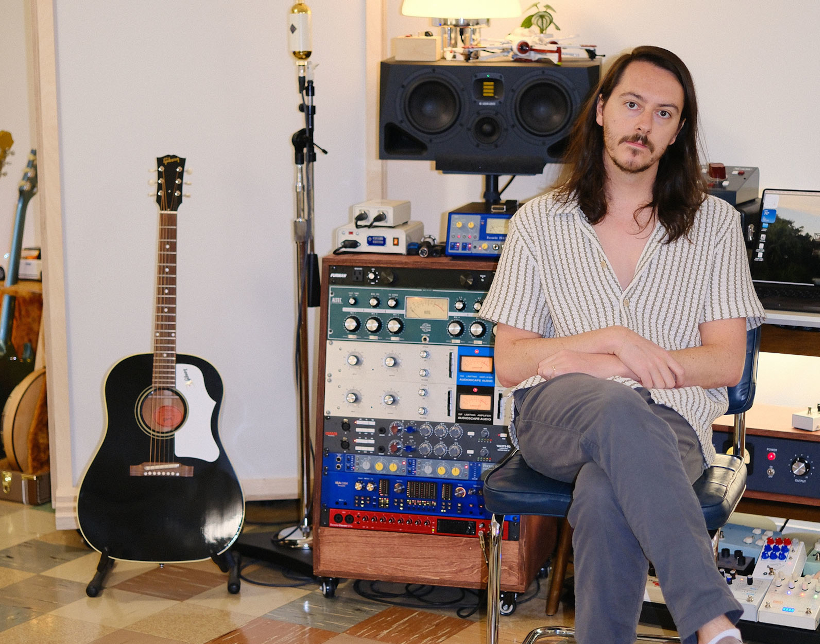
Steve Stout, owner and operator of Shabby Road Studio in Nashville and guitarist/co-producer for the American rock band Lifehouse, relies on Focusrite’s ISA C8X interface alongside ADAM Audio monitors and headphones. The Focusrite ISA C8X is a 26-in, 28-out USB-C audio interface that brings Focusrite’s transformer-balanced ISA microphone preamps into a standalone interface for the first time. Its first two channels feature ISA preamps built around classic Lundahl LL1538 transformers, with Console mode and 430 Air mode for tonal shaping, while all eight channels are fully controllable from the front panel or via Focusrite Control 2, alongside switchable impedance, balanced inserts, high-pass filtering, and the routing and recallability needed to run an entire studio.
Stout wears many hats: “Aside from being owner and operator of Shabby Road and guitarist and co-producer/mixing engineer for Lifehouse, I run our singer Jason Wade’s studio, recording Lifehouse music and his solo material,” he notes. “I’m in a band called ØZWALD, I release my own music as a solo artist under the name Steve Stout, and I freelance produce out of Shabby Road as well. Past credits include Blondfire, signed to Warner Bros.”
Stout describes his pre-C8X setup and how the C8X cleared new workflow avenues for him: “I had Focusrite’s Clarett+ 8Pre and OctoPre and was a huge fan of those units. However, the wall I kept hitting was needing more inputs for my ever-growing collection. I was already using the insert points on the OctoPre to hot-patch in extra gear, like my SSL bus compressor, just to have somewhere to plug it in. The C8X opened things up. What drew me in first was having the newest Focusrite converters as the brain of the system. But the bigger thing was the inputs. With switchable XLR and quarter-inch inputs, you’re really looking at closer to sixteen usable ins, not eight. That gave me room to keep gear like a Chroma Console pedal patched in full-time, gear I’d never bother connecting if I had to cable it in every session. Since I already had a Focusrite ISA Two and an ISA One, adding two more ISA channels gave me five total.”
Asked how straightforward the integration was, Stout comments, “It was simple. I’d considered jumping to a single 32-input interface since I use a lot of hardware. But that meant a headphone amp, more preamps, and expensive DB25 cabling with no TRS options. The C8X needed almost none of that. You can run TRS or XLR straight into the back with what you already have.”
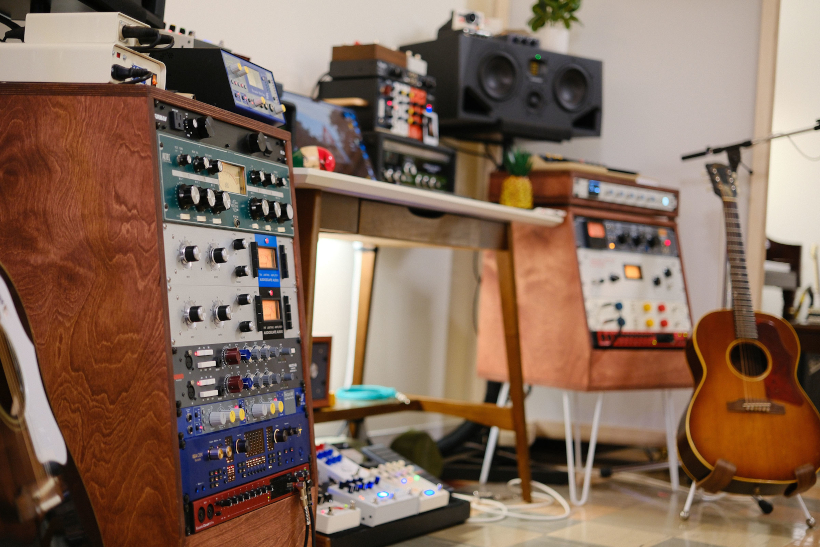
“It took about a day to fully rewire everything,” he continues. “I moved my OctoPre to my right sidecar and now send it back to the C8X over a single optical cable, instead of two four-channel snakes and extra cables. Focusrite sent a leather notebook with the unit, and I sketched an input chart for every interface before touching a cable, which made the rewire far less overwhelming.”
On choosing preamps for different instruments, Stout notes, “I run a lot of outboard gear: Mystery Magicians, Soyuz preamps, an old Altec, several compressors, and I don’t use a patchbay on purpose, so I’m not second-guessing routing every session. My main vocal chain is a Mystery Magicians into an AudioScape LA-2A, with a Blue Stripe 1176 on the insert.”
“But I’ve used the ISA preamps on just about everything, and loved it every time,” he explains. “People who call the ISA transparent or characterless haven’t really used one. To me it’s less spiky than competitors’ options. It just sees the whole picture, with more low-end information than most preamps capture, and driven hard enough, it almost sounds compressed on its own.” Stout points to a specific example: “Years ago, before I was on Focusrite gear, I did a one-mic challenge on a drum kit, positioned over the kick and using an ISA One against multiple preamps from other brands. The ISA was the only one that didn’t sound boxed-in and pointy.”
He describes how the C8X fits his current routing: “My Rhodes and its four-by-twelve cabinet are always mic’ed through the ISA preamps, and that same cabinet doubles as my go-to spot for bass guitar. Channels seven and eight return from my tape echoes, an Echo Fix and an old Roland Space Echo, and my toms and kick run through the transparent C8X pre’s. I kept hardware off the C8X and routed it into my Clarett units instead, since I trust these preamps most.”
On overall sound quality, Stout says, “It’s noticeably better. But the bigger difference is speed, how fast I can get things done. I go back and forth between mine and Jason’s [Lifehouse] studio, which runs an Antelope Orion, and I can’t point to a real difference in the mixes. Everything about this unit, the sound and how it looks, feels fully professional. I never feel like I need to upgrade.”
When it comes to impedance, insert points, and the Air modes, he says, “I use the drive and Air constantly: old Space Echo, toms, anywhere I want more life. With acoustic guitars through a condenser mic, though, trust your ears, since it can get brighter than you want. I love that Console mode is a slider instead of a switch, so you can dial it in exactly. Insert points are a huge part of why I like this gear. I’m running compressors on inserts across my setup, including a spare 1176 I just realized I can patch into channel one for my bass chain.”
Questioned about how the added I/O changes his approach to bigger sessions, Stout recalls, “I had the artist Theo Lawrence in for what was intended to be a video shoot, and it turned into a live four-piece session instead, all standing close together with no headphones. I ran the room off my ADAM A77H monitors, just the vocal coming through loud, which gave it a real live-show feel. At the same time, I built myself a separate headphone mix of the whole band through Focusrite Control to monitor while they played. I didn’t know how to do that going in, and I figured it out live, which says a lot about how intuitive the system is. The resulting track, ‘Theo Lawrence – In My Prime (Live at Shabby Road),’ is up on YouTube and required almost no mixing beyond running it through tape.”
As for who would benefit most from the C8X, he comments, “But it’s just as valuable for someone like me with a room already full of gear. With its headphone amps, talkback mic, and monitoring options, it’s a Swiss Army knife. But it’s a great first interface for someone starting out. You’ve already got excellent ISA preamps built in, and you could mic a full drum kit on the other six inputs and use the first two for everything else.”
His monitors get equal praise: “I run the ADAM A77Hs. My basement room is 850 square feet, and the A77Hs fill it evenly. They’re far less directional, so even at my synth wall, I’m still getting the stereo image, which matters with artists walking the room instead of sitting in my seat. I love Pure mode. It’s flatter, not sterile, but it still has enough low end to track and feel the bass.”
One feature of the C8X caught him off guard: “The built-in headphone outputs. I’ve got two from the C8X at the desk for me and whoever I’m working with, plus one each from the Clarett+ 8Pre routed to my piano and drum set, all running ADAM Audio headphones. That alone saved me from buying a separate headphone amp.”
Asked what he’d say to someone still on the fence, Stout offers this: “Dig into the input and output options, the mic/line switching in Focusrite Control, and the companion app that lets you dial in preamp gain from across the room. This interface is a big reason I’ve started tracking live full-band takes again. This unit looks and sounds as professional as I could ask for. No part of me feels like I need to upgrade to anything else.”