 How to resolve AdBlock issue?
 Conni Ettinger: A Career
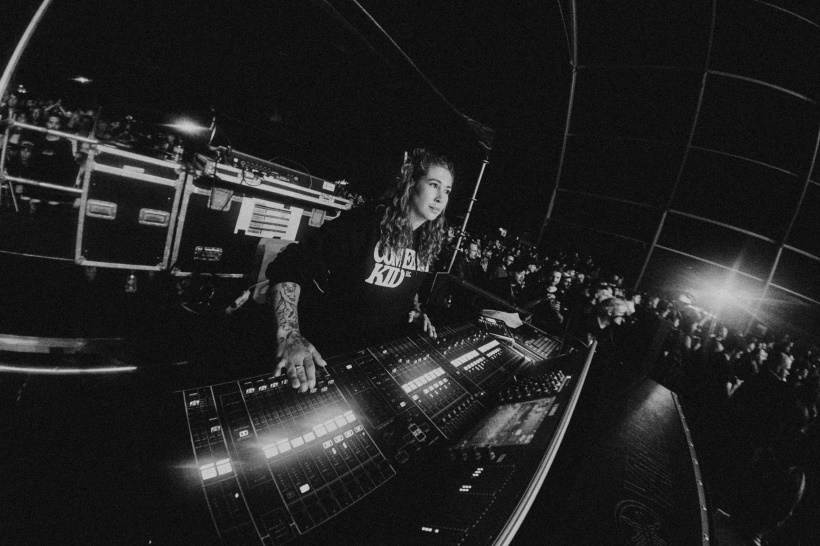
Her hands are moving almost constantly: During shows, Conni Ettinger seems to play the console like an instrument, pushing knobs, moving faders, touching interfaces. For Conni, it’s one of so many approaches to live sound: “Of course, I could automate certain things in my mixing, but I don’t want to. Because for me, it’s like playing an instrument. It’s like being a part of the show. I like to actually do things all the time instead of, I don’t know, just unmuting for a little snare bomb. I ride the faders, you know. There are many approaches to get your sound right – this is mine. My instrument is the console, and I’m playing it to my best.”
Conni loves to work with the same bands and to know their music: “I get the set list and even though I’ve mixed these songs a hundred times, I will listen to them before the tour because I want to know ‘what can I add to make it sound better?’ Is it a vocal throw? Is it a feature, a little solo here and there? Or is it a reverb, a delay or whatever? What can I add to make it sound better so that the people leave the show saying, wow, this was awesome. What can I add to the experience? I think that bands and musicians notice that you put in that effort. It’s almost like you play a part in the band, like you are really part of the band with what you can contribute.”
Today, Conni is on world tours with heavy music bands: Punk rock, ska, Deathcore or Metalcore: “It’s kind of the niche that I’ve found myself in. I like the music and the people because it’s a very accepting, generous bubble of really cool people.” Maybe surprisingly, her career started in church. The strict Roman Catholic church, to be more exact. Conni was a little altar kid back then and there was a young priest who let the kids and teens sing and try every instrument. Soon, they had their first little concerts with a small PA and a Behringer mixing desk. Young Conni was hooked, learning about XLR cables and everything else. At the age of 12, she recorded her first CD in the local youth center and had her first Cubase license at 14. She took two-hour train rides to Vienna just to discover live concerts from completely new perspectives: Crew. Tech. Changeovers. And a strong realisation that this is where she needed to end up. “And that’s what I did when I finished school,” she says.
Conni offered to help out, shadowed people, learnt, built a network. “That’s definitely the most important part in all of this,” she adds. “The whole industry is one big networking event. Every show is a networking event.” There have also been happy coincidences. Conni was 19 when a colleague of a colleague got sick. She tagged along, unloaded the trailer, plugged in the backline and helped with everything. “And then I stayed with that band for seven years, ending up doing front-of-house,” she says. New connections, local jobs in Vienna and additional band tours quickly followed.
Talking about routines in the job, Conni quickly mentions her preference to mix with DCAs. She laughs: “My whole setup is kind of based on that, I think because my education and my early years were also very heavy in studio work. In my mind, I kind of see a Pro Tools session in front of me when I see a mixing desk.” She typically sets up DCAs for drums, guitars, bass, backing vocals and vocals. That is the foundation: “I have an ‘All’ DCA with everything but the main vocals, I have an effect DCA and once I’ve dialed in my single signals, I go to that layer where I have my DCAs and I stay on that 90% of the show. I do a lot of little fader rides where I kind of follow the tension arc of the song with tiny adjustments. Like I will take down my all DCA 2-3 dB in a pre-chorus – and once the chorus hits, I’ll go back to where I was before to make the audience feel that the song is alive. It’s like breathing.” Even reverbs for vocals are never preset, but live-adjusted on the effects tab on the fly.
That also reflects her signature topic: “I put in the utmost effort to make the show, the sound better, to make the experience for the crowd as good as I can. Sometimes I feel like sound engineers kind of forget that you’re there for the crowd and not for yourself. That’s why we should roam through the crowd and listen on their listening positions instead of our throne at FOH. Do everything you can to make it sound good for the crowd. Basically that’s what I try to do.”
Another key competence she reflects on is not technical at all: “Technical skill level and the social part of the job are, to me personally, almost equally important. I guess everyone has worked with engineers that are grumpy, that maybe like to drink a few beers too many, that maybe take their hygiene not that seriously. If you live with them on a tour bus, it’s not the best. There are so many factors and I understand that a social part is equally important next to the skill level. Ideally you find someone who kicks ass at their job and is also really cool to be around. Plus you need to be able to read the room, handle different egos and calibrate to very different personalities. Otherwise, you’ll never be able to translate your expertise.”
Besides thinking of Pro Tools and the early days in that little youth center studio, Conni remembers another phenomenon from the old days: “When you’re in school, the range of jobs or careers you could pursue seemed a little narrow. We’ve advanced today, yes, but when I was in school, no one said, ‘you can be an audio engineer’. They said you could work in a bank, be a teacher or a doctor, a nurse or whatever. No one really talked about the technical jobs – apart from a catholic priest at my church, funnily enough.” She remembers very well that the first years in the industry can be hard: “If you are not 100% confident, people see ‘Oh, this is a young, shy person’ or whatever and they pick on you. And they might call you ‘cute’ little names or say inappropriate things.”
Conni continues: “Every show you will be asked ‘Should I carry this for you, it’s heavy!’ It can be very frustrating. It might only take just one bad experience that makes someone say, ‘**** this, I’m going to do something else’. Or, in my case, it gives you the urge to prove yourself, carry the heaviest pieces and be extremely well prepared, so as not to give any space for comments. You have to get over this hump of backlash that you might have in the beginning and it’s not easy. You just work extra hard and prove time and time again that you belong.”
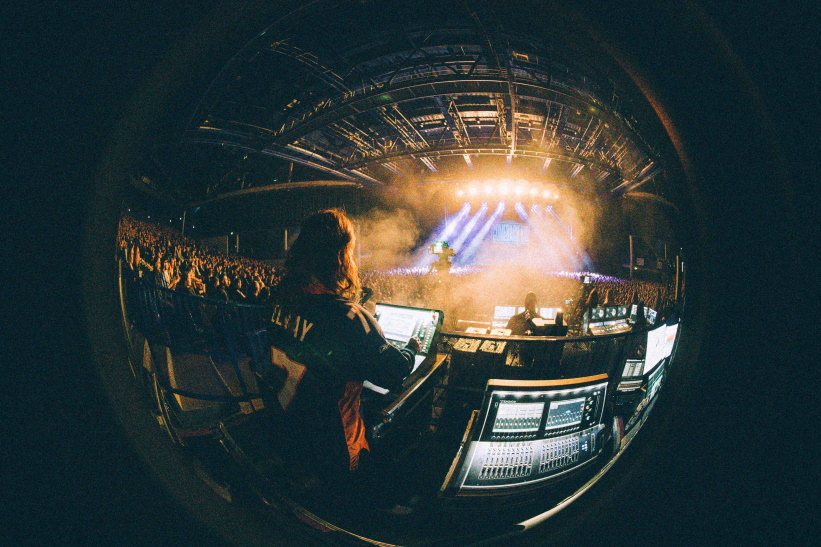
“So the women that we have in this industry? The few female colleagues that I have? I would vouch for them because they are amazing, and I’ve met a few that are simply incredible. And I know they had to go through all of this, too, to get to where they are. And that’s why they are so good. Maybe you could see it as the good side – if there’s a good side to it.” For Conni, it is a great sign to see that today, there are lots of initiatives that help women make their path: Women in Live Music in Europe, Sisters of Music in Austria, Sound Girls in North America. They all help and guide and offer a safe space.
To Conni, confidence is important in the game of live audio. You need safe zones to build the experience, to get the routines. It’s a big jump from audio school to the moment where you run a live show. You need to learn on the job, not from a book. “Live engineering is thrilling,” she says. “You have one chance to make it sound good, to make the signal flow work, for the musicians to play a good show. You play the song once. Generally I think I would like more hands-on education because I feel like a lot of people are afraid to take first steps in the industry. To get the practical experience. It would be so cool if we had workshops or trainings in venues every so often, it would help women and men alike.” That’s where confidence grows from, says Conni. “The more you work, the more hands-on experience you have, the better. You make mistakes and you have scary moments when things don’t work out, but you learn how to find quick solutions. With that you get more confident because at some point you know: Nothing can scare me anymore. I can handle every situation.” It is from that confidence that one might sometimes hear Conni say: “Let’s not soundcheck today”. Sometimes you also simply don’t have the chance to or you are missing half of the band.
It’s not the end of the world. Conni smiles: “I set everything up. I have my scene saved. We do a quick line check before the show. Then? First song starts and that’s where you quickly have to dial it in. It’s a very punk rock approach, but I trust my system and my gear. I know that sometimes, even in a stressful festival situation, all I can do is to pre-set up the desk, stage box, mics on stands, wireless frequencies… Just make sure all of this is done. And then the actual work concerning the mix and the music happens in the line check and first song. I know it can be done because my system and gear is reliable.“