 How to resolve AdBlock issue?
 Cordial ECOCORD FM 234 TOP
Environmentally friendly Microphone Cable for Professional Use
Author: Peter Kaminski | Photos: Peter Kaminski and Nick Mavridis (2)
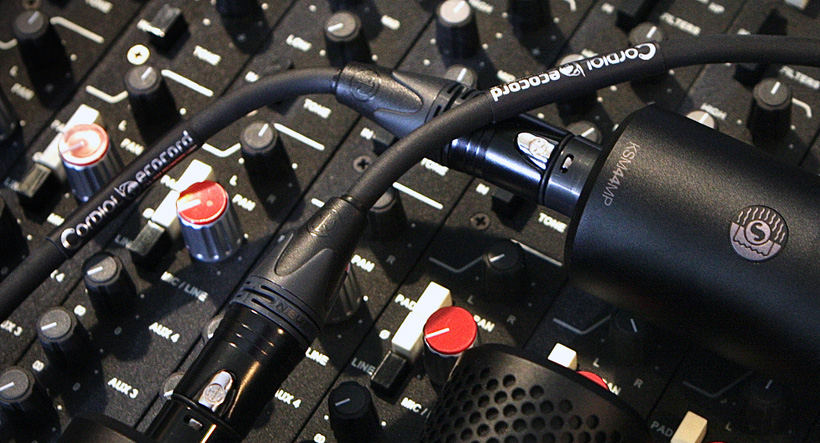
We’ve already reviewed Cordial’s Road cable series. In this review, we’d like to take a closer look at the Ecocord FM 234 TOP microphone cable, which stands out both in terms of the materials used and its technical specifications. Not all cables are created equal - and that can’t be emphasized enough.
ECOCORD Series
Cordial’s Ecocord series offers cables that meet high professional standards while also being environmentally friendly. The series includes various cable types, all of which are PVC-free. Take, for example, the ECOHEMP cables, which feature a TPE-V jacket wrapped in a hemp textile braid. In this review, however, we’ll focus on the ECOCORD cables without a textile braid.
Here is some additional information on PVC and the environment. PVC is not particularly environmentally friendly - even during manufacturing, as chlorine is used in its production. PVC is a thermoplastic polymer produced by chain polymerization from the monomer vinyl chloride, which is considered carcinogenic. Furthermore, plasticizers are used in PVC. There are therefore several reasons to avoid the use of PVC, especially since recycling PVC is also problematic.
TPE-V
For the ECOCORD series, Cordial uses TPE-V instead of PVC for the outer jacket. TPE-V is a thermoplastic vulcanizate - a compound that combines the stiffness of polypropylene (PP) with the elasticity of ethylene-propylene-diene rubber (EPDM). Due to its properties, it is now widely used in automotive manufacturing and the construction industry for seals and profiles.
TPE-V can be molded like a standard thermoplastic but behaves like rubber, offering high resistance to weathering and chemicals, as well as high resistance to UV radiation, ozone, and many solvents. The EPDM content improves flexibility at low temperatures, yet the material remains robust even at higher temperatures. It is, therefore, not a compromise material, but rather a modern, high-quality material with excellent properties. TPE-V has a rough surface and feels similar to rubber. Incidentally, when recycling TPE-V, the two components - PP and EPDM - can be separated by heating and then reprocessed individually. So, here there are advantages over PVC too.
Microphone Cable
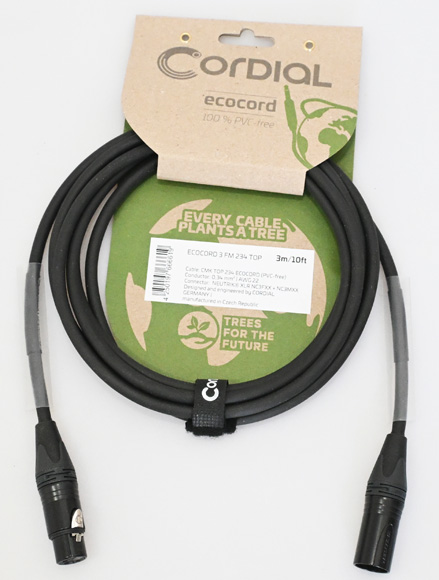
In 2025, the microphone cable from the ECOCORD family was introduced. It is marketed under the name ECOCORD FM 234 TOP and uses the CMK TOP 234 cable sold by the meter. The ECOCORD FM 234 TOP microphone cables are offered fully assembled in a wide range of lengths, from short patch cables to longer lengths for broadcast or stage use, in the following eleven lengths: 0.5, 1, 1.5, 2.5, 3, 5, 6, 7.5, 10, 15, and 20 meters. The cable is also available by the meter for custom assembly or installations with lengths of 100 or 500 meters.
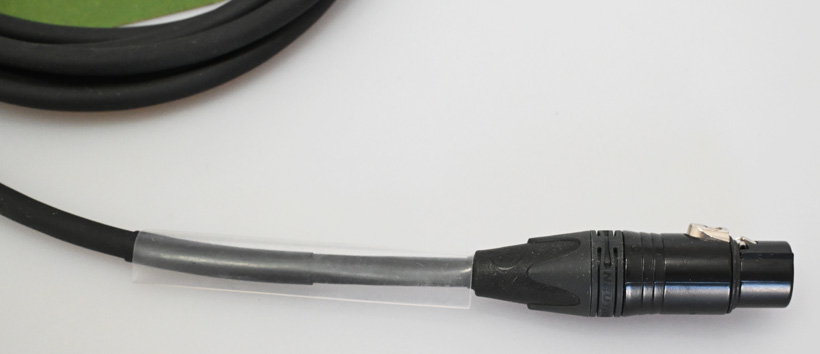
The connectors used are Neutrik’s NC3FXX-B and NC3MXX-B, featuring a black metal housing and gold-plated contacts for high corrosion protection and a robust collet strain relief. So the quality is top-notch here too.
Let’s take a closer look at the CMK TOP 234 ECOCORD cable. It has an outer diameter of 6.8mm and weighs 63 grams per meter. Important for permanent installations is that the minimum bending radius when stationary is only 34mm. Thanks to its rugged construction, the cable is suitable for both indoor and outdoor use. The operating temperature range is -20 to +70 degrees Celsius when in motion, and -25 to +75 degrees Celsius when stationary.
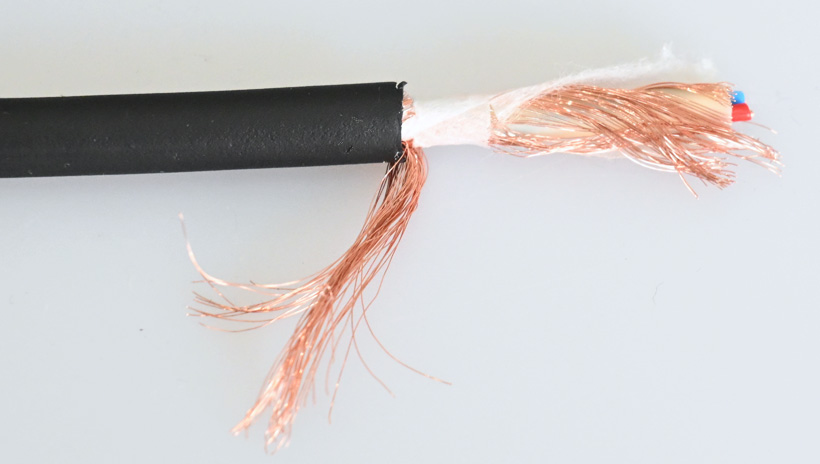
The photo above clearly shows the construction with the outer sheath removed. The two conductors (cross-sectional area 0.34mm², 44 x 0.1mm copper) are stranded in pairs and sheathed with a TPE-V conductor stabilizer, which stabilizes the performance geometry and thus ensures only minimal displacement of the conductors during movement. This also ensures mechanical decoupling of the conductors from vibrations and bending movements.
The conductors have a copper purity of 99.99 percent, and the conductor resistance is 53 ohms per kilometer. The cable features double shielding via two copper braids made of bare copper wires, which are wound in opposite directions and separated by a non-woven fabric. The oppositely wound shields increase the shielding coverage, and the non-woven fabric between the shields reduces abrasion between the copper shield layers.
In Practice
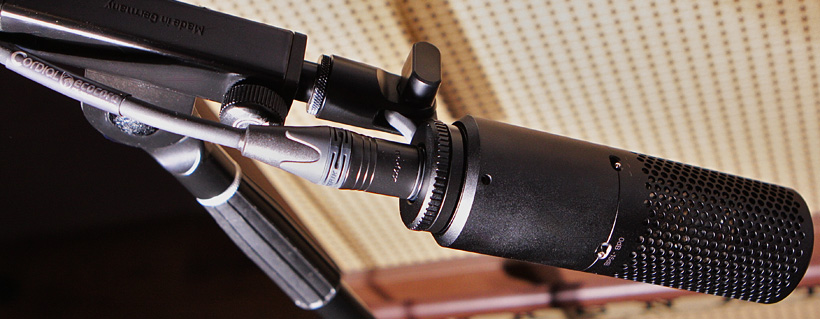
We’ve also used this cable in our microphone tests - such as when testing the Shure large-diaphragm microphones KSM44MP, KSM40C, and KSM32C - and have had very good results with it. Particularly important for the broadcast sector and for use in fixed installations is the high shielding factor with regard to high-frequency interference. Here, the design with the two counter-rotating braids achieves very high RF shielding while maintaining high cable flexibility.
Cable capacitance does not play as significant a role in microphone cables as it does in other applications - such as instrument cables - but we have nevertheless measured it at 46 pF per meter between the two conductors and 74pF per meter between a conductor and the shield. In terms of handling, there are no major differences between a PVC cable and the PVC-free ECOCORD cables.
Conclusion
The ECOCORD DM 234 TOP microphone cable combines a very high cable quality and a high RF shielding factor with Neutrik XX Series connectors - all while being highly environmentally friendly in terms of both production and recycling. The latter is an issue that should become an increasingly important criterion in product decisions. This must be emphasized here as well, because once you hear the difference with PVC-free cables, you wouldn’t attach this level of importance to the issue without the background knowledge we’ve hopefully provided here. It’s also great that Cordial, as a cable manufacturer, is addressing this issue in this way.
In terms of price, the cables are also reasonably priced for this level of quality. The cable is, of course, a true all-rounder for both studio and live sound. While everyone benefits from the RF shielding, users in broadcast and fixed installations will be particularly pleased. Avoiding materials that are harmful to health is certainly a concern for all users.