 How to resolve AdBlock issue?
 Tascam CA-XLR2d Camera Audio Interface
With Adapters for Cameras from Various Manufacturers
Author and photos: Peter Kaminski
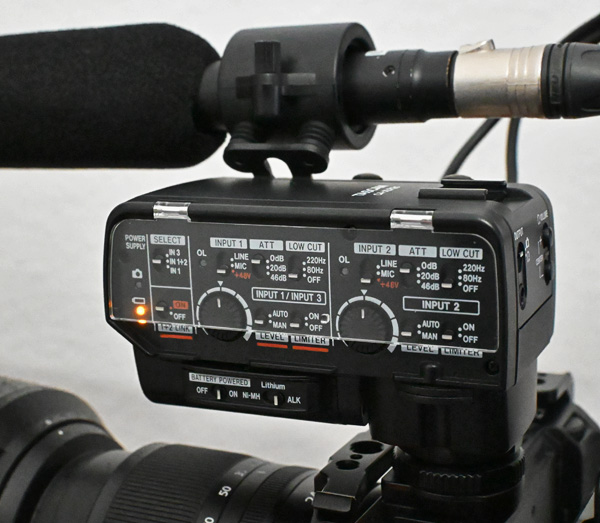
With the CA-XLR2d, Tascam has been offering an audio interface for cameras for some time now, which can be used universally in analog or digital form for certain camera brands or series via adapters. New since the end of 2025 is an adapter for the Nikon ZR video camera, for which the camera manufacturer now also offers a digital hot shoe adapter. We tried and tested the interface with the new adapter along with a Nikon ZR.
Concept
The product consists of the following components: the actual audio interface with a removable elastic mount for shotgun microphones, a battery holder, and a connection cable for analog operation with the camera.
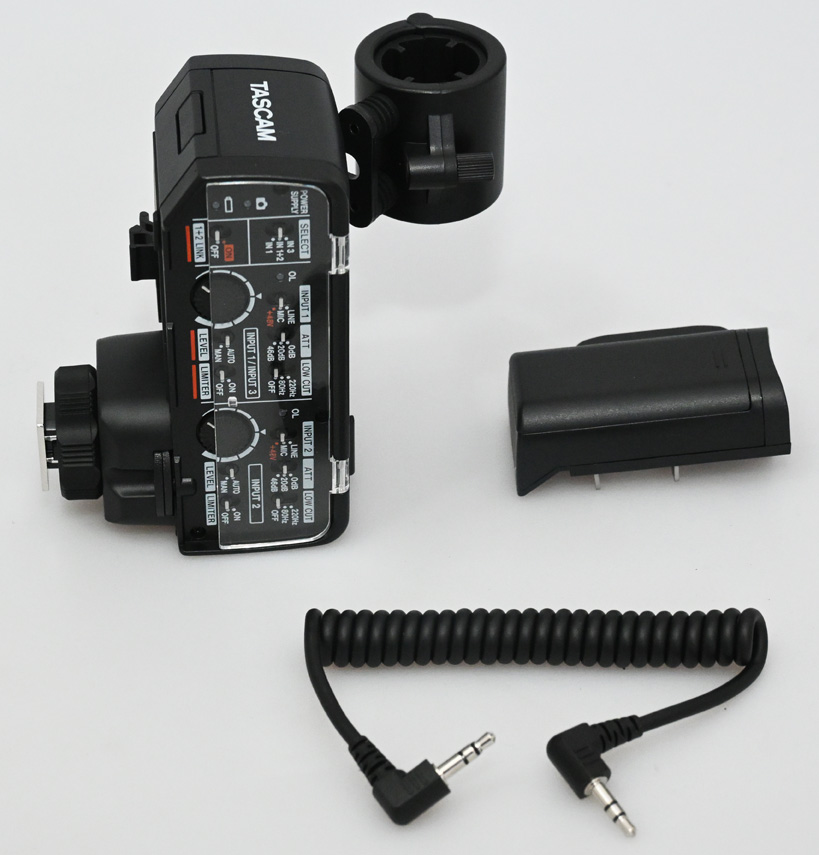
There are corresponding adapter options for the special versions with digital connections. This means that you can also retrofit an interface or convert it for use with another camera brand, but Tascam also offers ready-assembled sets for analog operation (CA-CLR2d-AN) for Canon Multiaccessory Shoe (CA-XLR2d-C) for the Fujifilm Data Communication Hot Shoe (CA-XLR2d-F), and for Nikon's digital hot shoe (CA-XLR2d-N). The retrofit adapters are available under the designation CA-AK1-x (-AN: analog, -C: Canon, -F: Fuji, and -N: Nikon).
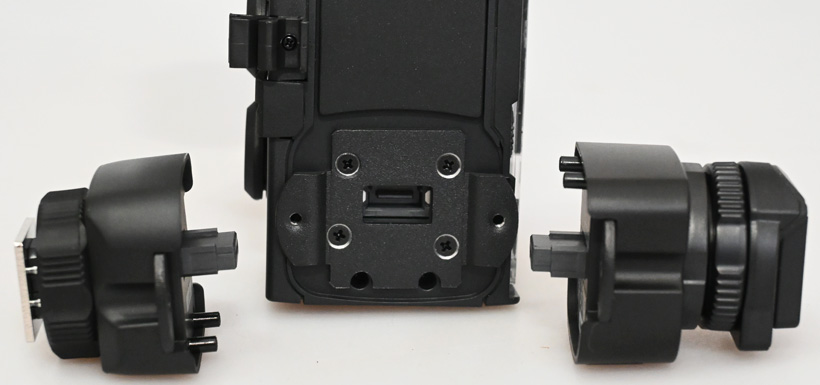
In the picture above, you can see the socket and mount for the adapter at the bottom of the interface. On the left is the analog adapter, and on the right is the adapter for Nikon's digital hot shoe. The conversion takes just a few seconds. The adapter has guide pins and holes so it cannot be accidentally attached the wrong way around.
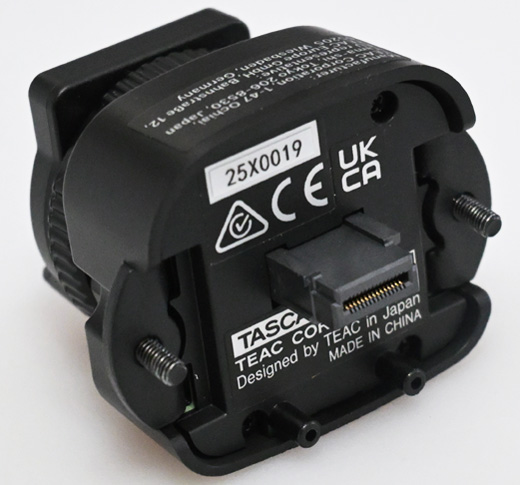
The picture above shows the CA-AK1-N for Nikon from the side facing the interface (top) and the other side facing the Nikon camera hot shoe.
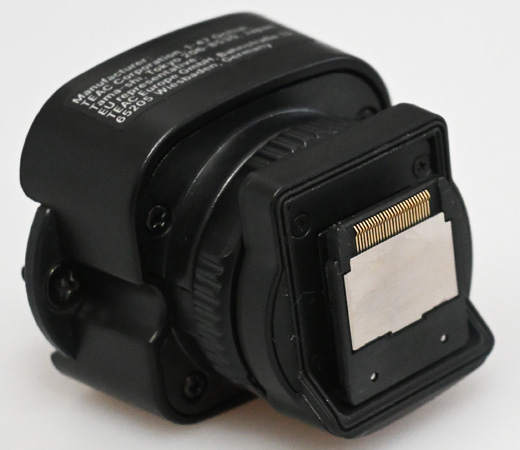
There is a cover to protect the connectors on both sides. Especially the contacts for the hot shoe should be handled with great care.
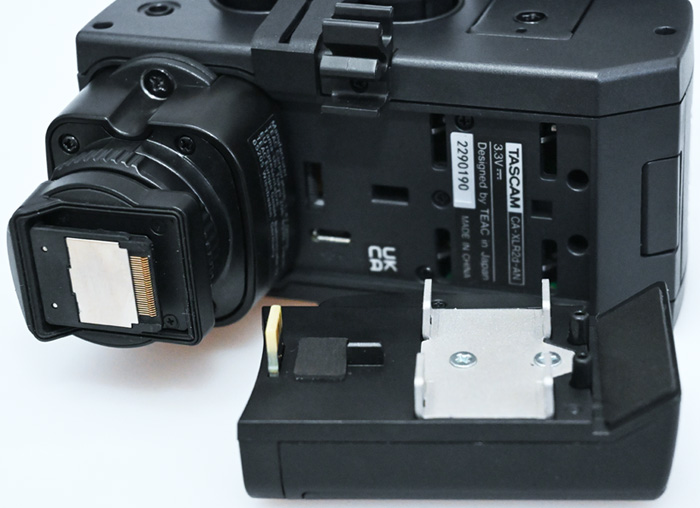
The supplied battery/rechargeable battery holder accommodates two AA cells. The housing is inserted at the bottom and locked in place. Pressing a lever releases the battery compartment.
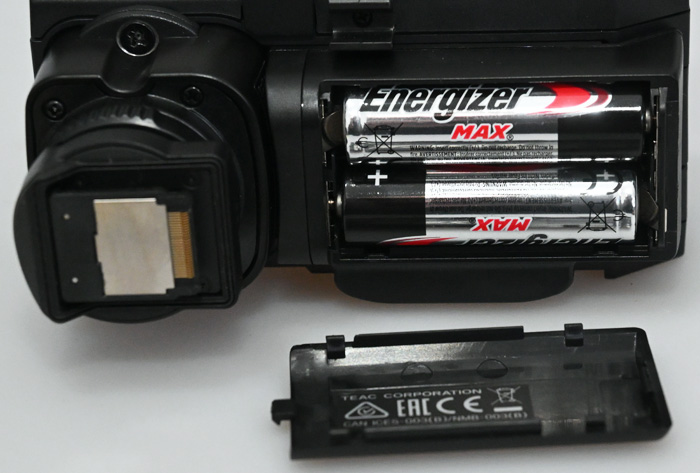
The use of batteries is important, for example, for phantom power. Together with the Nikon adapter, a maximum of 8mA operating current is permitted for phantom power without a battery, and 9mA for the Canon adapter. With the analog module, the operating voltage is supplied by the batteries anyway.
Connections
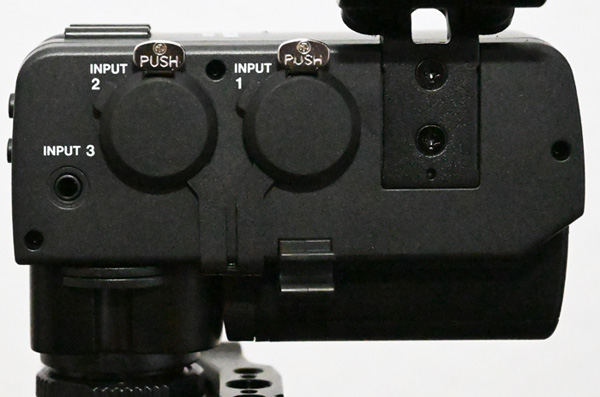
The CA-XLR2d offers three inputs: two electronically balanced XLR inputs and one unbalanced 3.5mm stereo jack socket. The XLR inputs can be switched between the microphone and line level, and the sensitivity of the inputs can also be adjusted.
More on this in the description of the operation. The internal sample rate is either 48 or 96kHz, depending on the camera setting, as is the word length, which is either 16 or 24 bits.
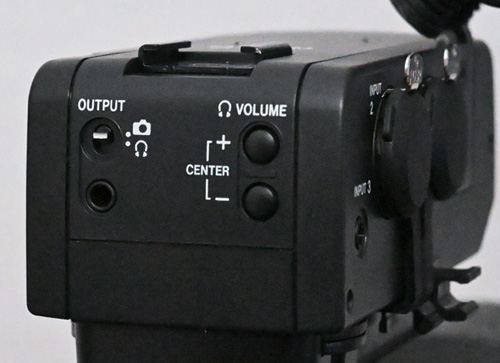
There is also an analog output, that, when using the digital hot shoes, can be conveniently switched to headphone mode and offers a power output of 8mW (0.1% THD, 16 ohms). The headphone level can be adjusted using two buttons. The output voltage for the camera switch setting is 0.29 Vrms.
Operation
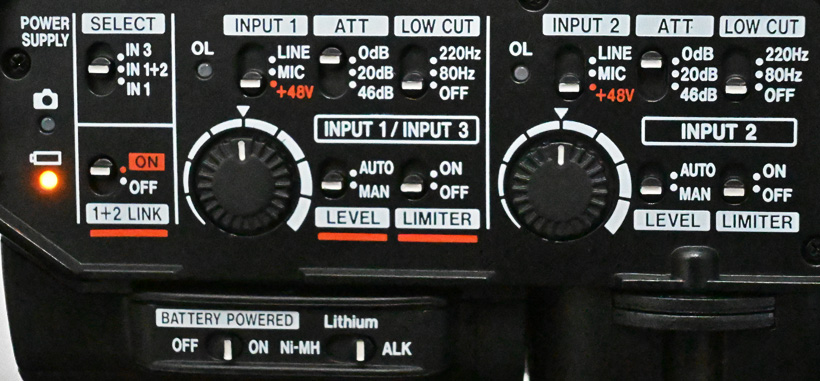
A hinged plexiglass cover protects against accidental adjustment of the settings on the CA-XLR2d. A switch on the battery compartment activates the battery power supply, while another switch allows you to select the battery type (NiMH, lithium, alkaline). Two status LEDs on the interface indicate the selected power supply.
The input is selected using the three-position SELECT switch. The LINK switch allows both channels to be adjusted simultaneously in terms of level and limiter. The input sensitivity can be set automatically or manually using a knob. The gain range is 66dB. Each of the two input sections, which are functionally identical, offers an overload indicator (OL) and a switchable limiter. The respective input can be switched to microphone level (input impedance > 2 kiloohms, max. input level +6dBu, minimum input level -60dBu) or line level (input impedance > 10 kiloohms, maximum input level +24dBu, minimum input level +4dBu) and an input attenuation (0, 20dB, or 46dB) can also be activated via the ATT switch. The INPUT switch can also be used to activate the 48-volt phantom power supply for a connected microphone. LOW CUT can also be used to activate a high-pass filter with cutoff frequencies of 80 or 220Hz.
In Practice
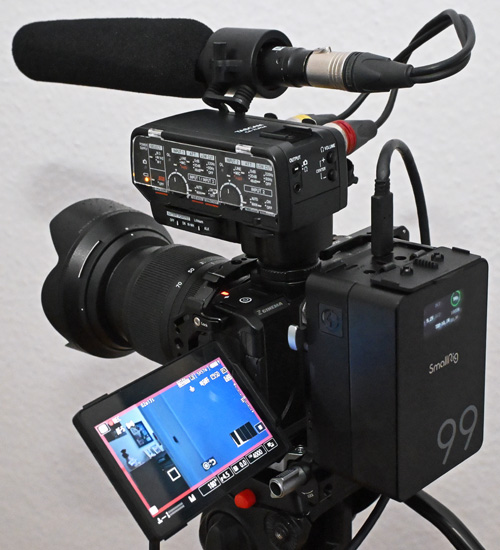
We tested the CA-XLR2d along with a Nikon ZR with a digital hot shoe and various shotgun microphones (see figure above). Many of the following specifications therefore refer to this configuration, but they can of course be applied to other camera models and manufacturers.
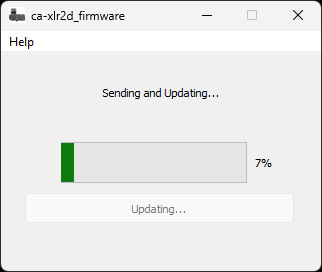
Before using the CA-XLR2d for the first time, we had to update its firmware. Software for this purpose can be downloaded from the TASCAM website. The update to version 1.20, which is required for operation with the Nikon digital hot shoe, went smoothly.
The elastic mount for the microphones is very sturdy and can be removed with two screws when not in use. However, the mounting is such that no standard alternative mount, such as those from Rycote, can be attached as a replacement. An alternative is the hot shoe on the CA-XLR2d on the top of the housing at the rear of the audio interface. Here, for example, you can attach a Rycote Universal Camera Kit. However, this is only worthwhile for larger microphones and very high requirements for acoustic decoupling and wind protection, as the standard elastic microphone mount of the CA-XLR2d is already very good.
As expected, the audio technology is as good as one would expect from Tascam in terms of noise performance, sound quality, and functional capabilities. One minor drawback is that the internal conversion in the CA-XLR2d is not in 32-bit float, but a maximum of 24 bits.
The housing of the CA-XLR2d is mostly made of plastic, but it is still robust. With cameras, every gram less is welcome, so the plastic housing is a practical solution. The operation is familiar and similar to that of many larger video cameras with an audio section. It is also interesting to note that when using the Nikon ZR, the audio interface is switched off when the CA-XLR2d is running on battery power and the camera is switched off, thus conserving battery power. It can be assumed that this is also the case with the Canon and Fuji versions.
Apart from the input selection, there is no need to consult the manual, as everything is self-explanatory. The small practical details are also worth mentioning, such as: cable guides on the side of the audio inputs, covers for the XLR inputs that are connected to the housing, a hot shoe on the top to replace the occupied hot shoe on the camera, and the aforementioned removable microphone mount. It's clear that Tascam has years of experience in the field of audio interfaces and recorders for cameras.
Conclusion
The price for the analog version, Tascam CA-XLR2d-AN, is around $450, the set for the Nikon ZR is around $600, and the CA-AK1-N adapter for converting to a Nikon digital hot shoe, if you already own another CA-XLR2d set, is app. $300.
For example, if you see the Nikon ZR as part of a modular system with V-mount power supply, quick-change tripod mount, and want to work professionally with larger shotgun microphones, or if you sometimes have to deal with other external sources, you will certainly opt for the Tascam CA-XLR2d-N audio interface - because this product is unrivaled for professional use, offers high quality, and is reasonably priced in relation to the camera. That is why we will be using it for our proaudio.tv video productions in the future.