 How to resolve AdBlock issue?
 Audio-Technica ATV-SG1
Directional Clip-On Microphone for Video Cameras
Author and photos: Peter Kaminski
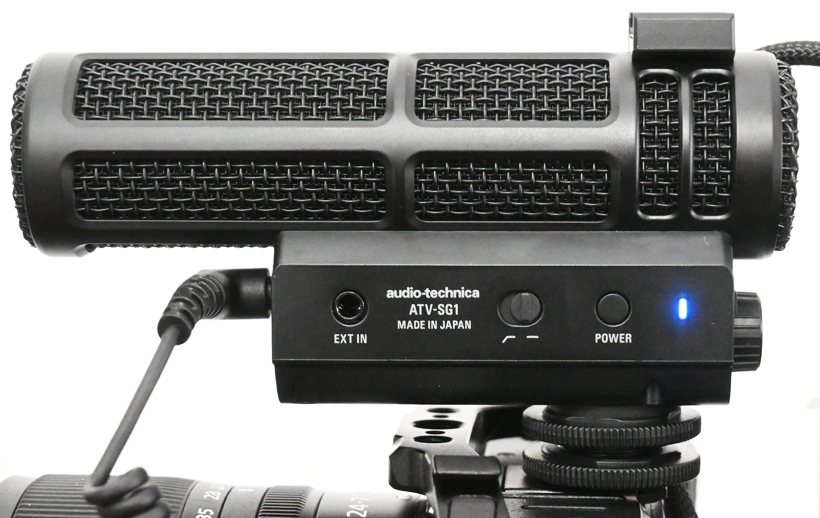
Mirrorless cameras with video capabilities (or vlogging cameras) are becoming increasingly popular for professional video recording. Compact video cameras, such as the Nikon ZR, are as well. Thanks to DSP technology and microphone arrays, the audio quality of these cameras’ built-in microphones has improved significantly. However, this technology still cannot replace a high-quality directional microphone. That’s why there is a whole range of compact shotgun microphones with hot shoe mounts available. Examples are the ATV-SG1 from Audio-Technica, which we’d like to introduce here, as well as its little brother, the ATV-SG1LE - which we haven’t tested, but we’ll briefly touch on the differences between the two microphones.
Scope of Delivery
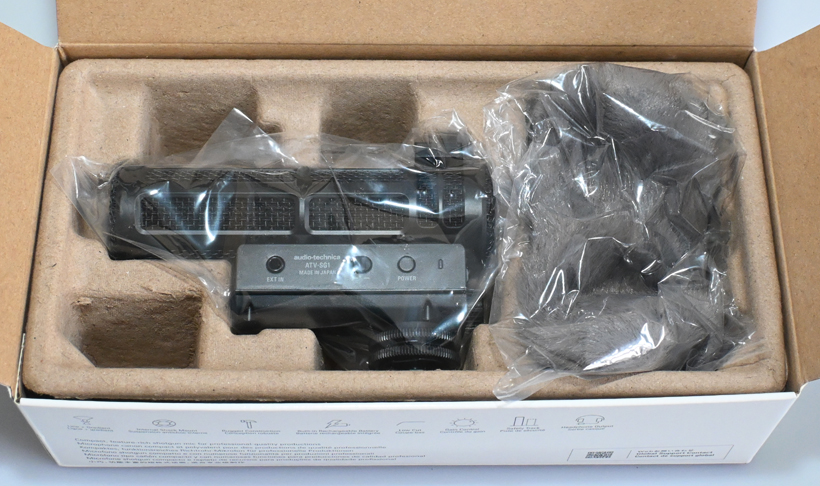
Let’s first take a look at the scope of delivery.
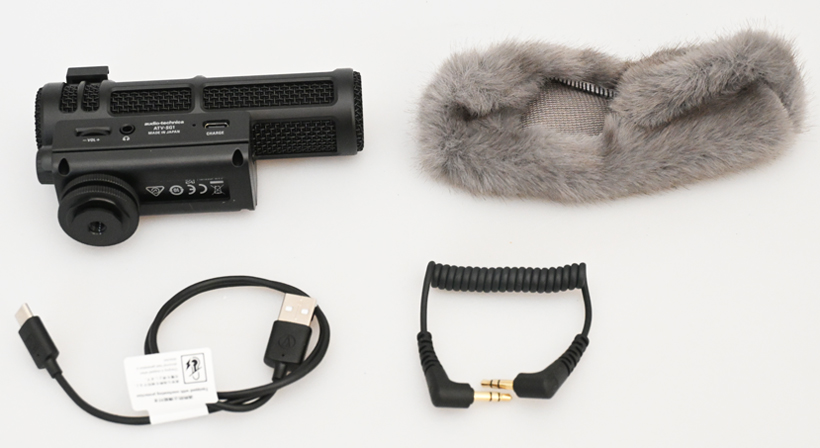
The package includes the microphone, a fur windscreen, a USB cable for charging, and a short coiled cable (up to 0.5m in length) for audio connection to the camera. A carrying pouch is not included.
Design and Technology
The microphone is a directional shotgun model with a length of 128mm and a weight of 155 grams. The housing is made of metal with a black finish. It features a 100mm acoustic tube, and the permanently polarized condenser capsule has a diameter of 14mm. The polar pattern corresponds to a supercardioid with a special suppression of side lobes. Internally, the acoustic tube and the capsule are elastically mounted to suppress handling noise. The manufacturer specifies the frequency range as 60Hz to 20kHz. At minimum gain, the maximum sound pressure level is 132dB SPL, and the dynamic range is 109dB, both at 1kHz and 3% THD. The signal-to-noise ratio is specified as 77dB (1kHz @ 1Pa, A-weighted). The gain adjustment range is 37dB.
The microphone features a built-in amplifier. Power is supplied by an integrated lithium-ion battery (single-cell) that can be charged in 2.5 hours and provides approximately 24 hours of recording time without using headphones. A headphone amplifier for direct monitoring of the audio signal before it reaches the camera is built-in. With a load impedance of 32 ohms, it delivers an output power of 100 mW. The minimum load impedance is 16 ohms, though this is of no practical significance.
Operation
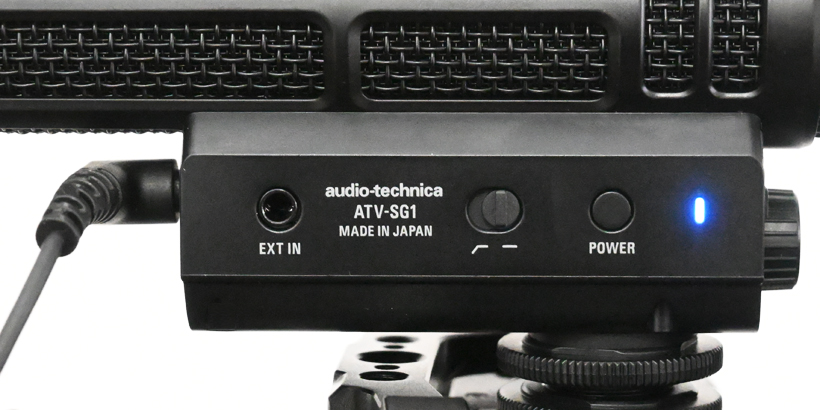
The output cable connects to the 3.5-mm stereo jack on the front of the microphone. On the right side of the housing is a soft button to turn the microphone on or off, with an LED serving as a power indicator.
An external signal can also be fed in via a jack on the side, which can be switched to the camera as an alternative to the microphone signal. A 160 Hz low-cut filter with a 24 dB/octave roll-off can be activated.
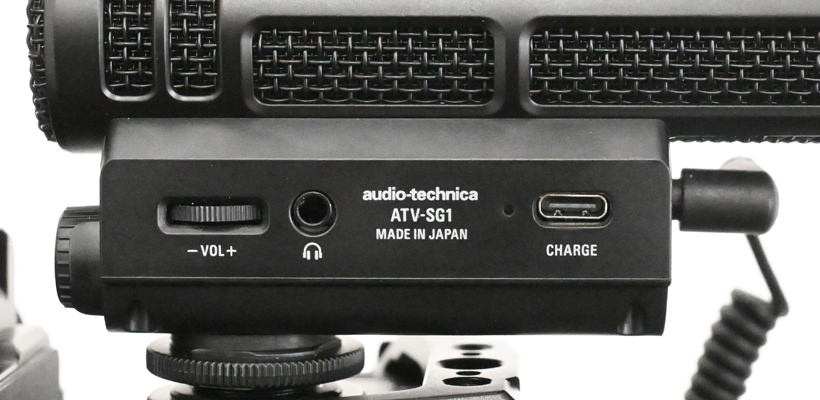
On the other side of the device, you can connect headphones and adjust the output level continuously. The USB-C port is used to charge the internal battery.
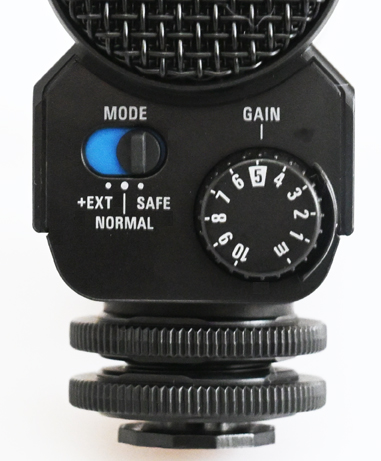
On the back, there is a knob for continuously adjusting the microphone gain and a three-position switch that allows you to select the alternative external source and toggle between Normal and Safe modes. In Safe mode, a signal attenuated by 6dB is output on the right channel. So if channel 1 clips, channel 2 can be used as an alternative.
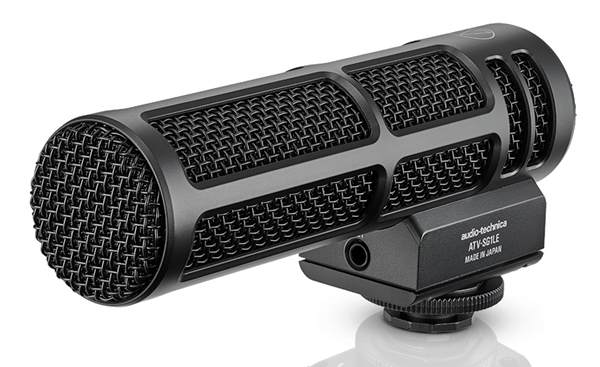
The ATV-SG1LE looks very similar to the ATV-SG1, but it has no controls - meaning no adjustable microphone gain, no Safe mode, and no switchable low-cut filter. Power is supplied externally via the camera cable with a phantom power supply of 1.5 to 5 volts. The maximum sound pressure level here is 114dB SPL and the dynamic range is 102.5dB (@1kHz and max. SPL). Acoustically, the ATV-SG1LE has the same design and features the same capsule.
In Practice
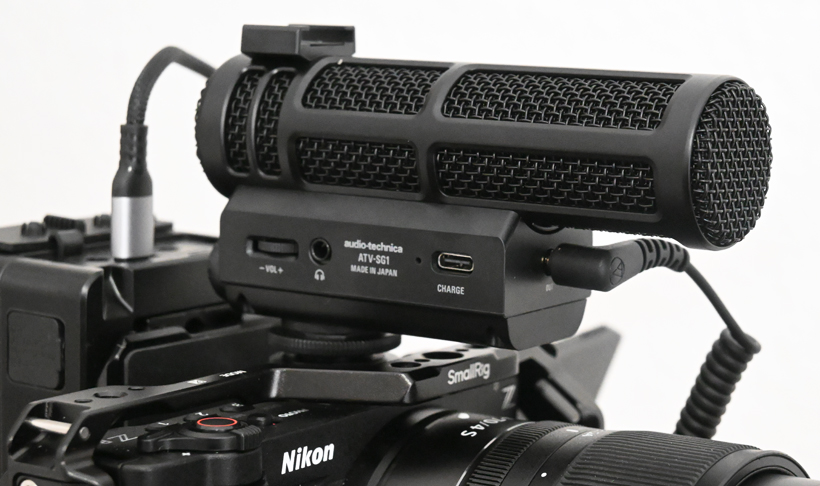
We tested the ATV-SG1 with a Nikon ZR. One advantage is that the ATV-SG1 features a hot shoe at the top. So, for example, if you want to use a small LED light, you can mount it on the microphone.
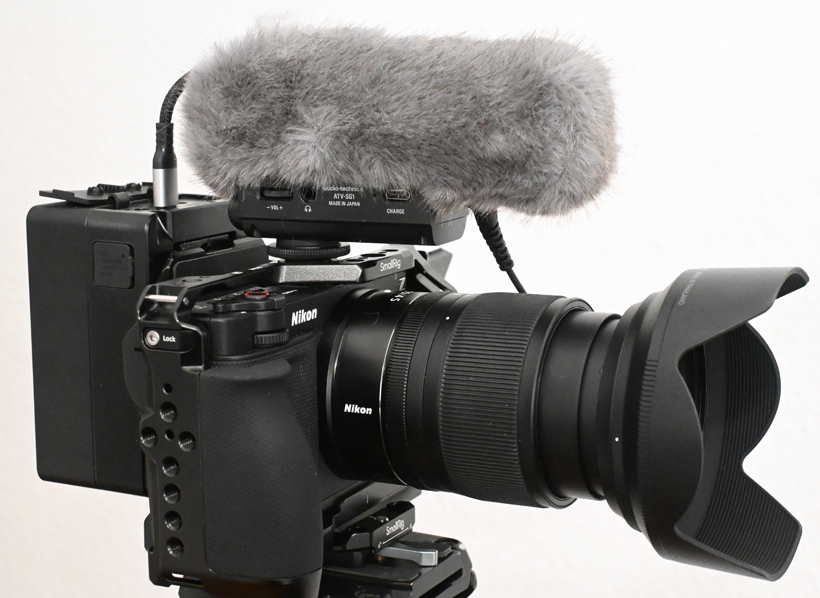
The hot shoe mount on the microphone does not have a rectangular plate at the bottom; instead, it is beveled on multiple sides. As a result, the microphone sits slightly looser than usual, even when secured. However, the beveled hot shoe mount has the advantage of allowing you to adjust the microphone’s angle to the right or left in 30-degree increments.
We compared the ATV-SG1 with the Nikon ZR’s internal microphone. Thanks to DSP technology, you can already specify a directional pattern (front, rear, or omnidirectional) here. We set it to front-facing and compared it with the ATV-SG1. Even at close range, you can hear a clear difference, as the recordings made with the ATV-SG1 have significantly less room and ambient sound at a relatively close distance of one meter. The sound is very balanced, and speech intelligibility is also very good and improved compared to the internal microphone. For its compact size, the ATV-SG1 does a great job in terms of sound quality. The ATV-SG1LE, which we did not test, is likely to achieve similar sound results but has fewer connection and control options - and most professional users certainly do not want to record without the switchable high-pass filter and the ability to record in two channels at two different levels (Save mode). Additionally, operating with the internal battery is always preferable to powering it from the camera.
Handling noise is well absorbed by the elastic suspension. During normal camera operation, no unwanted background noise is generated during recording. The microphone grille also provides very good protection against noise caused by light winds. For protection against noise caused by stronger winds, simply attach the fur windshield. The hot shoe can still be used even with the fur windscreen attached, as there is a cutout provided. However, the windscreen isn’t quite as easy to attach. It could have been a bit larger or more elastic.
Conclusion
The price of the ATV-SG1 is around 200 euros, and that of the ATV-SG1LE is around 100 euros. It makes sense that the ATV-SG1 is twice as expensive as its smaller counterpart, as the LE version offers significantly fewer features and is aimed more at semi-professionals on a tighter budget. The price of the ATV-SG1 is absolutely fair and appropriate for its high build quality. The metal housing is very robust - something that’s no longer a given these days - and in terms of sound quality, it’s also superior to modern internal camera microphones with DSP technology.