 How to resolve AdBlock issue?
 Soma Warp
Multi-effect Device for Live Use
Author and photos: Peter Kaminski
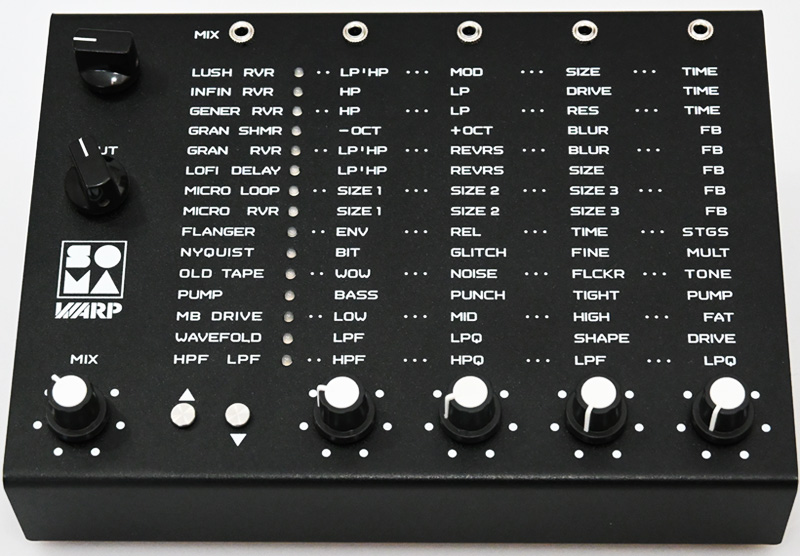
We have already reviewed several products from the manufacturer Soma, such as Cosmos and Flux, including the Break Out Box. All Soma products are somewhat unique, with a strong emphasis on haptics and a distinctive sound. The EU website describes this as “romantic engineering” - a charming and apt description, in my opinion, because Soma's concept is to combine a vintage feel with modern technologies. This is also the case, if you want to anticipate it, with the Soma Warp, a multi-effects device that was introduced in November 2025.
Connections and Technical Data
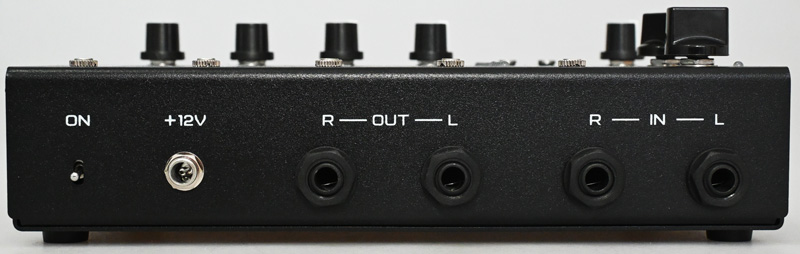
The scope of delivery for the Warp includes a universal power supply (100 ... 240V, 50/60Hz) with adapters for the most common plug types. The device has a classic barrel jack (5.5/2.1mm, positive pole in the middle), so that it can also be powered by another 12-volt operating voltage. The operating current is approximately 0.25 amps. However, with a footprint of 220 x 170mm and a height of 70mm (weight 1.5kg), Warp is slightly larger than typical guitar effects units and is designed more for desktop use.
Although the inputs and outputs are unbalanced, the 6.3mm TRS jacks are wired so that balanced input sources and destinations can also be connected. Inputs and outputs are designed to be stereo. However, if only one input or output is connected, the input or output will operate in mono. The input impedance is 50 kiloohms and the output impedance is 100 ohms. The manufacturer specifies a minimum input voltage of 0.35 volts peak-to-peak and a maximum of 8.3 volts peak-to-peak. The sample rate is 48kHz with a word length of 24 bits. The frequency range is specified as 10Hz to 22kHz. Calculations are performed internally with a word length of 32 bits.
There are also connections on the front panel, namely five 3.5mm jack sockets. Various parameters can be controlled via these CV inputs. As is usual with Eurorack modules, the voltage range is from 0 to 5 volts. The input impedance here is 50 kiloohms.
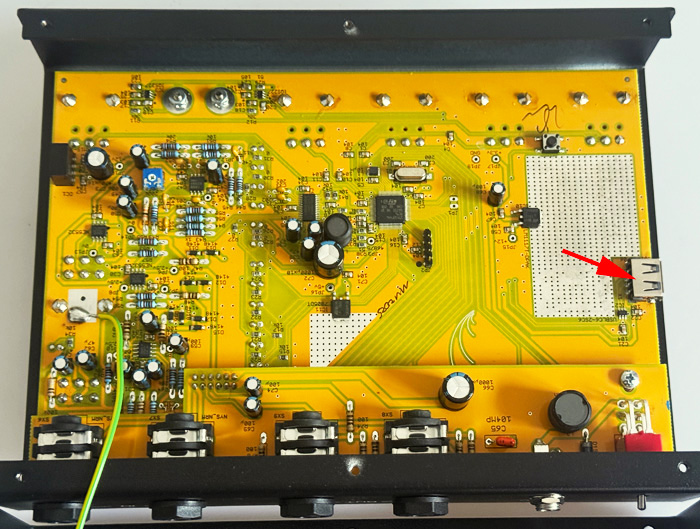
Firmware updates can also be installed. To do this, you have to open the device (see fig. above) and then a socket (see red arrow in the fig.) is available for a USB stick. There is also a push switch at the top edge for activating the update during power-up.
A successfully completed update is indicated by the LEDs on the front panel flashing repeatedly from top to bottom. We were able to install the latest firmware version 1.1 without any problems at the time of testing.
Concept and Algorithms
Before we talk about how to use the device, we would like to introduce the 15 different algorithms or effect types that Warp has to offer. There are four adjustable parameters for each algorithm. Soma classifies the effects into four groups and symbolizes them with different LED colors:
- 5 x reverb effects (blue),
- 3 x delay effects (green),
- 3 x special effects (yellow),
- 4 x master effects (red).
Let's now take a look at the individual algorithms. LUSH REVERB is a delay line-based reverb. With very short decay times, it produces a chorus effect. INFINITY REVERB is a classic reverb that simulates a large hall, which, with long decay times, transitions into an endless sound and even self-generates sound structures. All other reverb algorithms also offer an endless sound when set to appropriately high times. GENERATIVE REVERB is an experimental reverb effect. The algorithm also allows you to adjust the resonance strength of the high- and low-pass filters. GRANULAR SHIMMER is a granular reverb effect with pitch shifting, while GRANULAR REVERB offers an experimental granular reverb effect with continuously adjustable reverse reverb strength.
Now to the three delay effects, which also transition into an endless sound at very high feedback settings. The name LO-FI DELAY speaks for itself. MICRO LOOPS and MICRO LOOPS REVERB are effects with three loops in a large audio buffer, very similar to what you know from Soma Cosmos.
The special effects include a flanger that can be modulated over its delay time using an envelope follower. This means that the volume has an influence on the delay time. The degree of this modulation can be adjusted. NYQUIST is a sample rate converter with an integrated bit crusher, resulting in a reduction in digital word length. This effect group also includes OLD TAPE, a tape recorder simulator with adjustable wow and flutter effects, as well as noise and tape saturation effects.
The so-called master effects are three dynamic effects and a filter. PUMP is an extreme compressor effect with an adjustable bass booster and a switchable noise gate. MULTIBAND DRIVE offers distortion divided into three frequency bands and an adjustable harmonic boost via the FAT parameter. High FAT settings result in self-oscillation. The third effect is a WAVEFOLDER with a switchable noise gate. Then there is HPF LPF, a classic filter algorithm with high-pass and low-pass filters, as well as adjustable filter frequencies and filter resonance strength. If the high-pass frequency is lower than the low-pass frequency, the two filters are connected in series. If the high-pass frequency is higher, the filters operate in parallel.
Operation
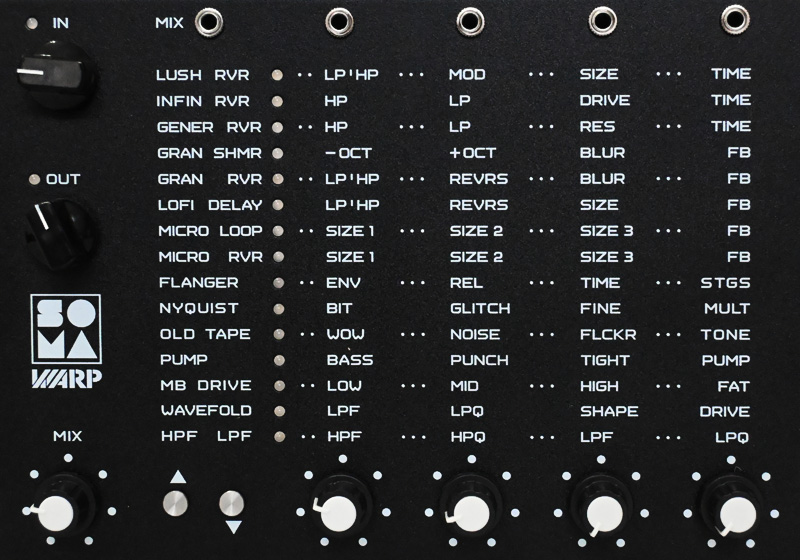
Now let's move on to the operation of the Warp. On the left side, there are knobs for input sensitivity, output level, and effect amount. Two touch sensors allow you to select the desired effect (up or down).
An LED indicates the selected effect. The four adjustable parameters of the algorithms are marked on the front panel and assigned to the corresponding knobs. There are no presets. In addition to the four adjustable parameters, the effect amount can also be controlled via an external control voltage. Touching both sensors three times quickly locks or unlocks them.
In Practice
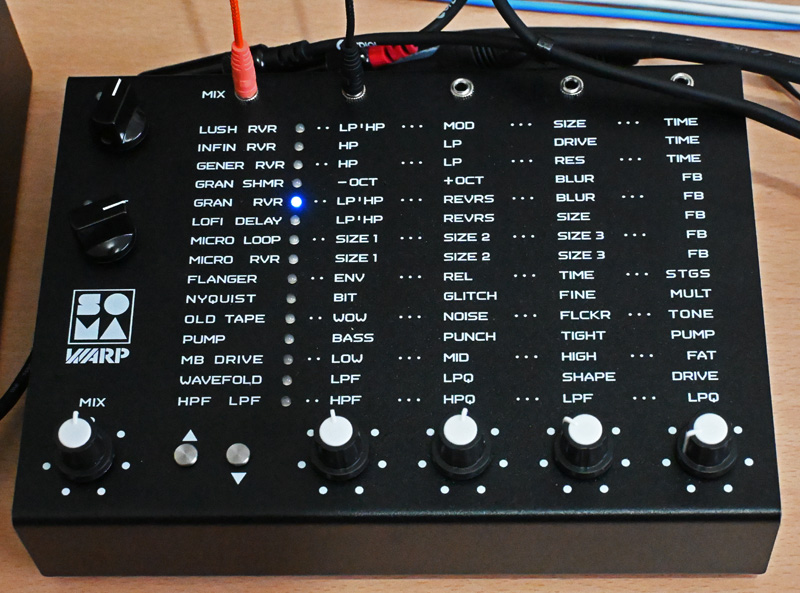
The workmanship is very good, and the metal housing makes a very robust impression. The very brief description of the handling of the Warp shows how simple and straightforward it is. There are no complicated menu structures, just direct controls for all functions, which are clearly labeled on the front of the device. This makes Warp ideal for live applications, as the concept allows you to dynamically change parameters such as filter cutoff and reverb times during live performances, forcing self-oscillation and adding musical accents.
Effects devices are usually structured differently: they have many parameters and presets that can be called up, so they are designed more as effects that can be added on. Warp gives you more dynamic real-time design options and influence. Warp is also ready to use with modular synthesizers or Eurorack modules thanks to its CV inputs. This allows even more complex sequences to be realized via a step sequencer or other modulation sources, achieving very interesting effects that cannot be achieved with other multi-effects devices.
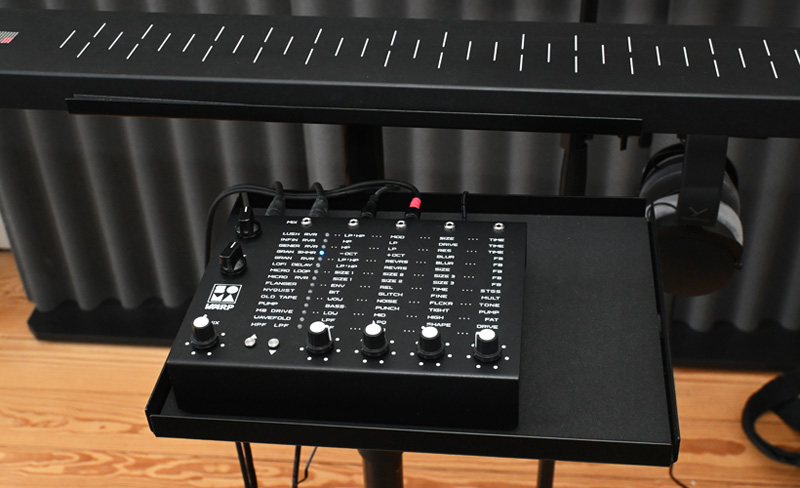
We also tested the Soma Warp along with the Soma Flux. A perfect pairing in terms of sound. You get significantly more effect potential here than with the integrated effects in the Flux. Incidentally, we used the König & Meyer 12227 shelf (see image above), which can be attached to the speaker stand using a clamp, as well as to speaker stands from other manufacturers.
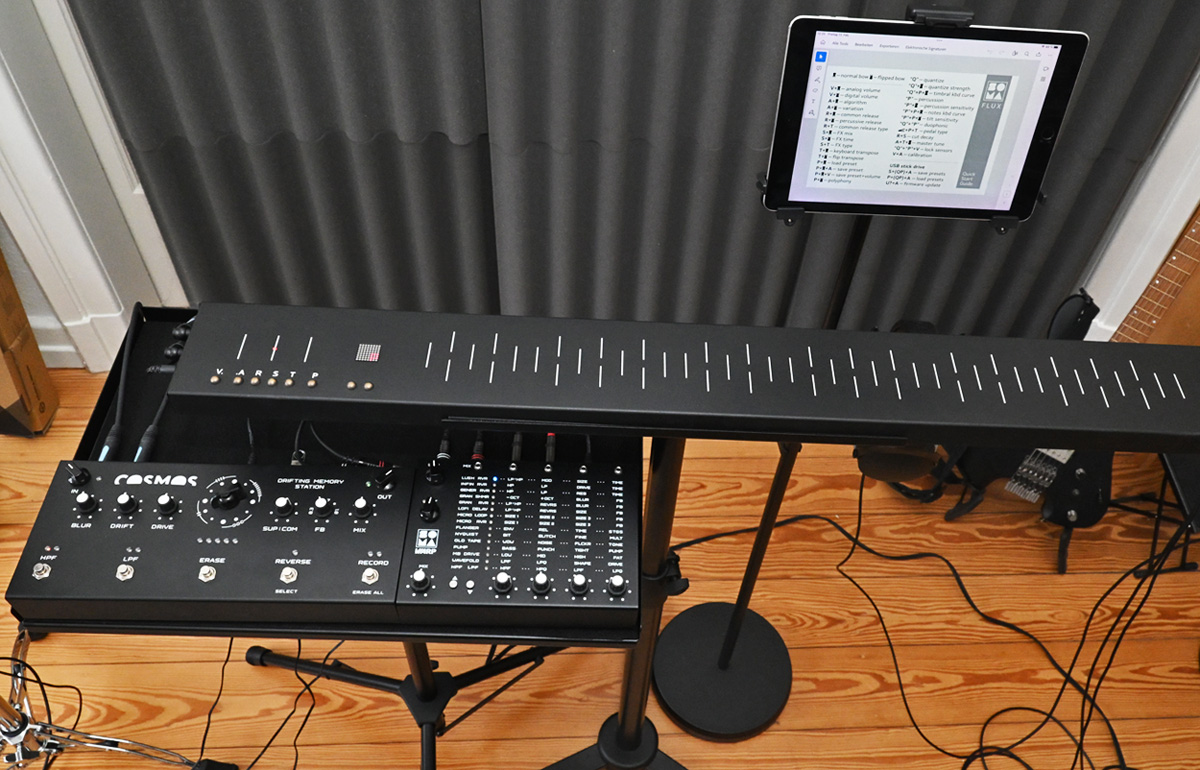
Another alternative is the König & Meyer Percussion Shelf 13500 (see pic above), which is best positioned to the left below the Flux. The Soma Cosmos and Warp fit perfectly side by side on the shelf, as if the shelf was made especially for this setup. Arranged this way, you can make manual changes to the Warp or Cosmos with your left hand while playing the Flux. I generally preferred to connect the output of the Flux to the Cosmos and then the output to the Warp. Sometimes, however, the reverse makes more sense, and then you just have to rewire. The advantage of this is that you have a headphone output available at the end of the chain via the Cosmos.
Now let's move on to evaluating the sound and algorithms. The A/D-D/A conversion is of very high quality for an effects device. I was particularly impressed by the five stunning reverb algorithms. I would classify them as creative reverb. Unlike simple room simulation, they offer very unique characters. I first tried them with the Flux, but they are also excellent for synthesizers and electric guitars. When playing, you can achieve a great deal of variation by manually changing or CV-controlling the TIME, FB, and SIZE parameters. The same applies to the three echo algorithms. Some of them sound very experimental, and I mean that in a positive way. This makes sound design a joy.
It is important to mention that a soft clip limiter is activated at the output at high levels, which may produce distortion. If you don't want to use this distortion in your sound, you'll have to lower the input level. The dynamics and filter algorithms are not as experimental and are used for finer sound manipulation. The Wavefolder, for example, is not nearly as extreme as you might expect from Eurorack modules, but it can be used with a wider range of sources. Niquist is a bit more extreme in its sound results. With the Pump algorithm, you can create a powerful and round to aggressive bass.
Conclusion
Soma Warp - a unique multi-effects device - costs around 700 US$/€. Warp is an excellent multi-effects device for live and stage use, both in terms of operation and algorithms. Warp is also ideal for use with Eurorack due to the possibility of CV control of the effect parameters. I can't think of an alternative product that covers a similar range of applications and offers such practical operation and sounds. A product with many unique selling points.