 How to resolve AdBlock issue?
Violet Audio dMIX 128
19" Rack-Mount Mixer with AES67 and MADI
Author and photos: Christian Boche
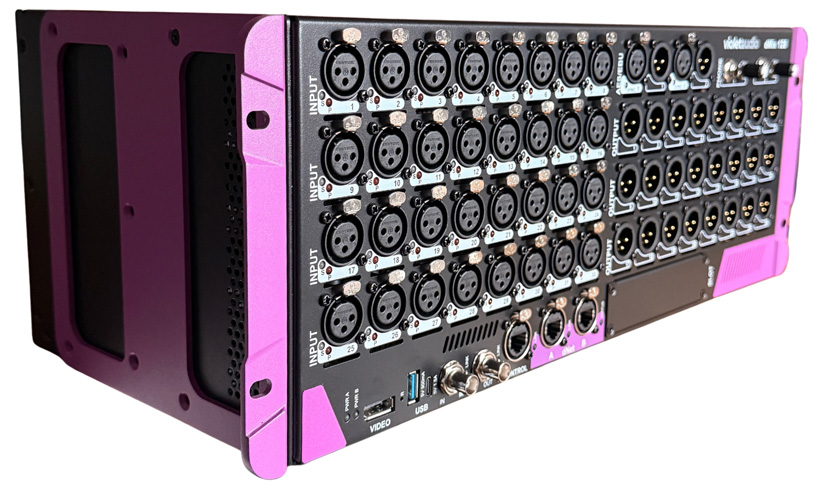
The Violet Audio dMIX 128 is a high-quality 19-inch rack mixer with remarkable features. It was developed in part by the same team responsible for the Soundcraft UI mixer series. As a result, the basic operation of the dMIX 128 should feel familiar.
Konzept
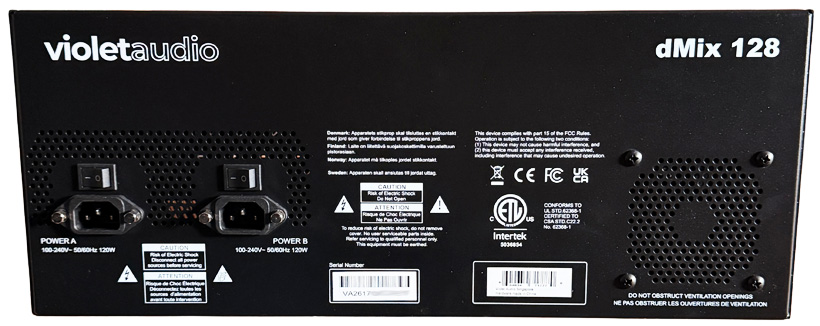
The dMIX 128 does away with a dedicated control panel entirely: There is no touchscreen, faders, or encoders on the 4-U chassis; all operation is handled via a browser-based HTML5 interface over a network. Internally, an FPGA engine with 32-bit floating-point resolution and a maximum sample rate of 96kHz distributes the signals across 88 internal buses and a 12x8 matrix. With a depth of 240mm (including the encoder), it weighs exactly 7.45kg, making it a compact and comparatively lightweight unit. Two redundant power supplies exist to enable uninterrupted continuous operation in studios, on stage, or in broadcast environments.
Connections
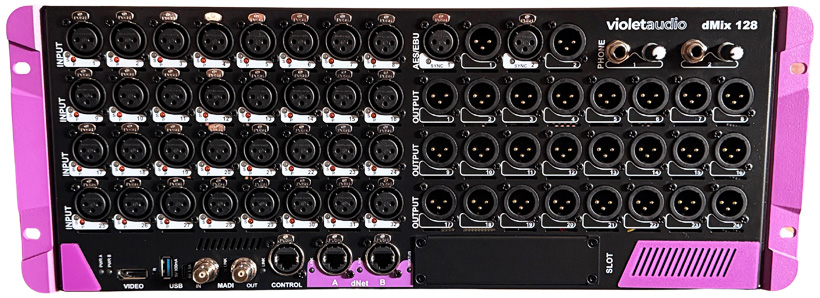
On the analog side, the front panel features 32 microphone/line inputs and 24 outputs in the XLR format. The gain range is -4dB to +50dB; the maximum input level is 28dBu at -4dB gain; and the dynamic range is 115dB (at -60dBFS, 20dB gain, 1kHz, A-weighted), and the equivalent input noise is -128dBu (at 50dB gain, A-weighted, and 150 ohms impedance). The outputs have an impedance of 50 ohms; the maximum output level is 24dBu (at 0dBFS); the dynamic range, according to the manufacturer, is 115dB (-60dBFS, 1kHz, A-weighted), and the frequency response within ±0.1dB is 20Hz to 40kHz at a sample rate of 96kHz. There are also two headphone outputs, each with 150mW of output power into 16 ohms and a dynamic range of 100dB.
On the digital side, there are two AES3 ports compliant with the AES3-2009 standard, featuring 110 ohms of input impedance, as well as a MADI interface via BNC with 64 x 64 channels. Following a future firmware update, the USB port will also be able to handle up to 64 x 64 channels. In addition, there is another USB-C port and a DisplayPort output for an external touchscreen. One slot is reserved for expansion cards, and two additional AES67 ports integrate the console directly into the audio network.
Network Connection
According to the datasheet, the dMIX 128 processes up to 256 network channels in total. AES67 is built-in and, according to the manufacturer, operates in a ring topology, intended to provide additional reliability. AES67 is also the protocol of choice for connecting multiple dMIX 128 units into a larger system. Dante itself is not included as standard equipment but can only be added via an optional expansion card. A documented, proprietary protocol is also available for connecting to control systems such as Crestron, Q-Sys, AMX, or BSS. Four device slots are provided for remote control of external network devices, along with two driver slots for CoreAudio and ASIO, respectively.
DSP and Channel Strip
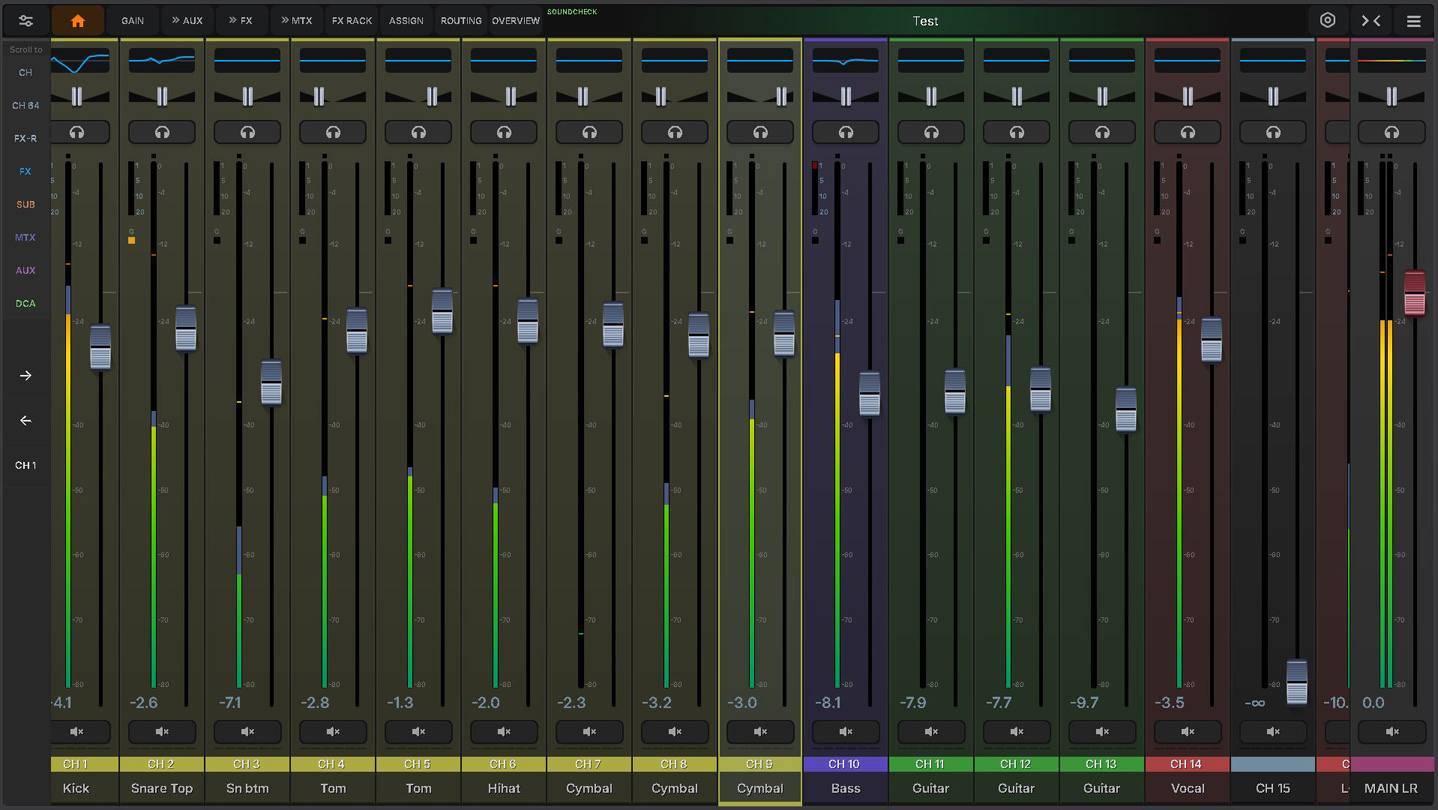
Twelve subgroups, 16 DCA groups, six mute groups, and 24 aux sends are available for internal signal routing. Each of the 128 channels features a parametric four-band EQ that can be expanded to include up to EQ filters if needed. The EQ points can also be switched to dynamic filters. A total of 128 DYNEQ inserts are built into the unit. High-pass and low-pass filters are also available separately with selectable slope, as well as up to 18 graphic 31-band equalizers with a control range of +/-15dB. For dynamic processing in the mixer channels, options include a gate, a compressor, a de-esser, a saturator, and multiband compressors with a sidechain input.
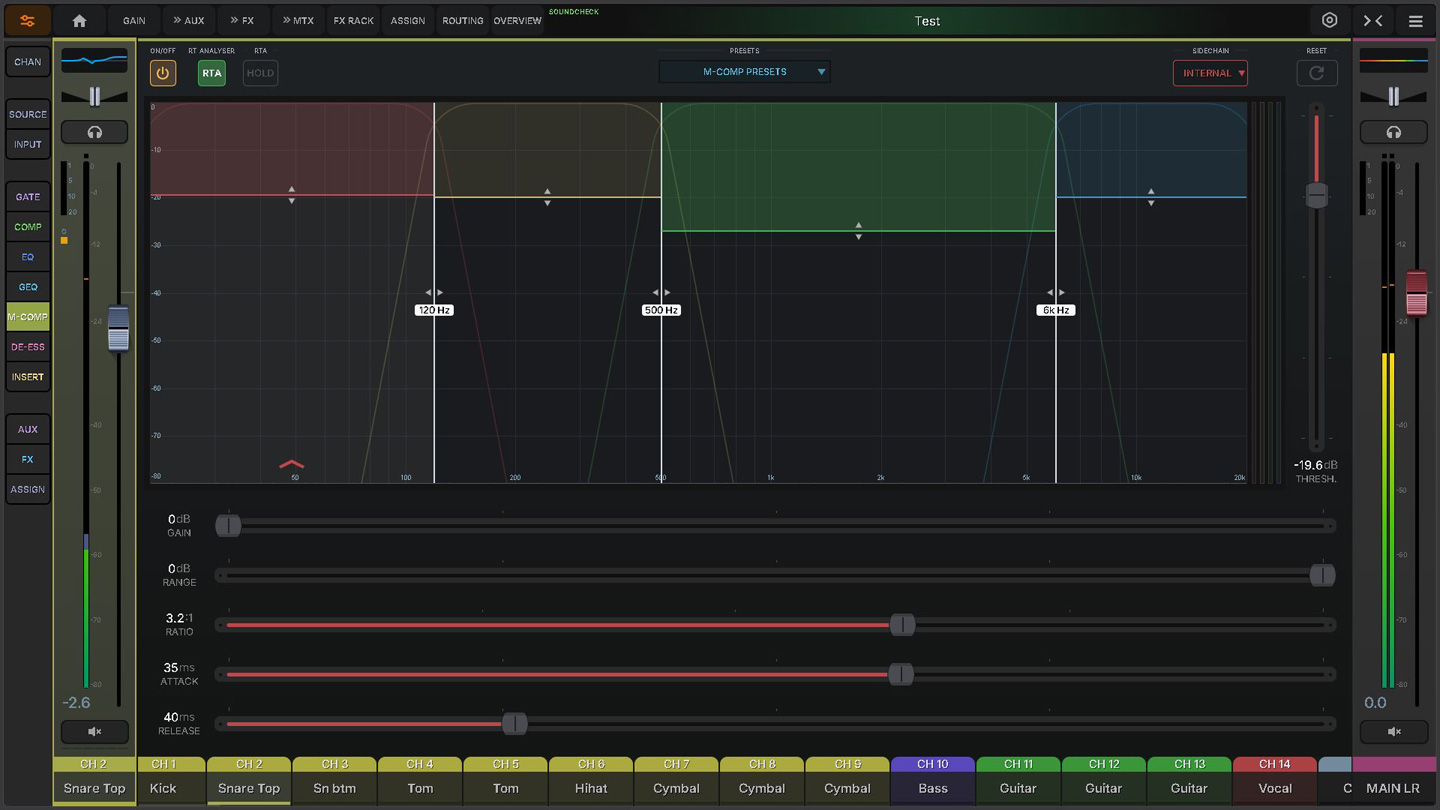
According to the datasheet, six ARM-based and two FPGA-FX engines are built in for effects, along with four slots for external effect units. An RTA analyzer, a noise generator, and an oscillator round out the featuress of the mix engine.
Control
The dMIX 128 is controlled exclusively via a browser-based HTML5 interface, which is accessible by default at the address dMIX.local on the local network. No separate app or software is required. In practice, up to 20 external devices can be connected simultaneously, such as tablets or smartphones running iOS and Android. Drivers for the AES67 audio interface are available for download on the manufacturer’s website. Additionally, the dMIX 128 includes a built-in MCP (Model Context Protocol) server, which allows the console to be controlled by default via port 1711 using AI applications such as ChatGPT or Claude, without replacing the existing remote control methods via OSC or browser.
In Practice
During testing, the AES67 driver for Windows ran consistently stable and, in addition to pure latency monitoring, provided its own tuning recommendations that could be applied automatically if needed; for example, the driver automatically changed the Windows power plan on my Lenovo T470 laptop. If the physical AES67 connection is disconnected, the console requires a computer restart to be recognized again. The built-in MADI interface also proved stable when used with an RME Madiface USB.
Contrary to what is described in the datasheet, the USB interface was not yet available as a full-fledged audio interface, regardless of the operating system. According to the manufacturer, this will be addressed in an upcoming firmware update. When connecting a touchscreen via DisplayPort, a native DisplayPort cable was chosen, as a DisplayPort-to-HDMI adapter caused connection drops during testing. Alternatively, without a touchscreen, almost all common MIDI fader controllers could be integrated for tactile control; a dedicated hardware control unit from Violet Audio is still pending but is expected to be released soon. To be fair, it must be said that the mixing software was optimally designed for touchscreen operation, allowing users to achieve the desired results quickly.
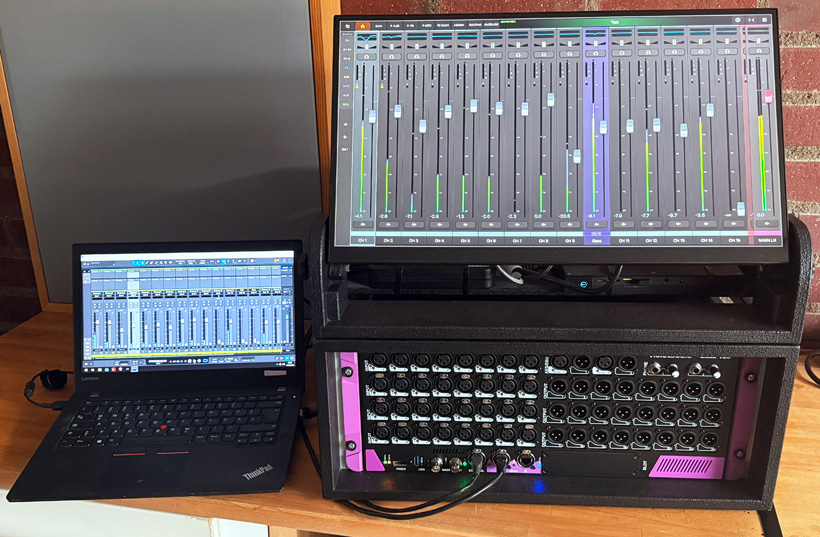
The fans are temperature-controlled; at normal room temperature, they occasionally ran for about a minute during testing and then shut off again. In a quiet studio monitoring environment, the fan noise might prove to be distracting. Regarding latency values, the manufacturer’s specification of 0.3ms was actually lower in our test: Using my Smaart measurement setup, I was able to measure a sensational 0.25ms for the purely analog path from input to output. An activated graphic EQ added about 0.02ms, the de-esser another 0.02ms; all other channel EQs and dynamics processors had no measurable effect. With channel processing fully activated, this resulted in a total latency of between 0.25 and 0.29ms. Combined with browser-based control via up to 20 simultaneous connections, this low latency makes the dMIX 128 an attractive option as a monitor mixing console, since each musician can log in using their own tablet or smartphone to adjust their own mix. To this end, the mixing software also includes access control to prevent less experienced users from accidentally accessing the wrong mixes.
The browser-based control - which requires no additional software - and the low latency also make the dMIX 128 an attractive option as a high-quality monitor mixer for musicians with their own tablets or smartphones. Up to four dMIX 128 units can be operated in a cluster, cascaded via the AES67 interface. This makes it possible to handle even larger productions. The fact that Dante is only available as an optional upgrade and that both the USB audio interface and a dedicated hardware control unit were still missing at the time of testing should be factored into the purchasing decision.
Conclusion
The Violet Audio dMIX 128 costs approximately 6,500 euros. In terms of feature set and networking options, the Violet Audio mixer ranks among the most advanced products currently available on the market, offering extensive network connectivity via AES67 and MADI with up to 256 network channels, as well as a well-designed dynamics and EQ section with 128 DYNEQ inserts and 18 graphic equalizers. For fixed installations, broadcast, and rental applications with the appropriate network expertise, the dMIX 128 remains an interesting alternative to established rack mixers, especially since it offers several special features that prove to be very helpful, such as an MPC server, dual power supply, numerous I/Os, and much more.