 How to resolve AdBlock issue?
EITB relies on Lawo HOME mc² DSP Processing
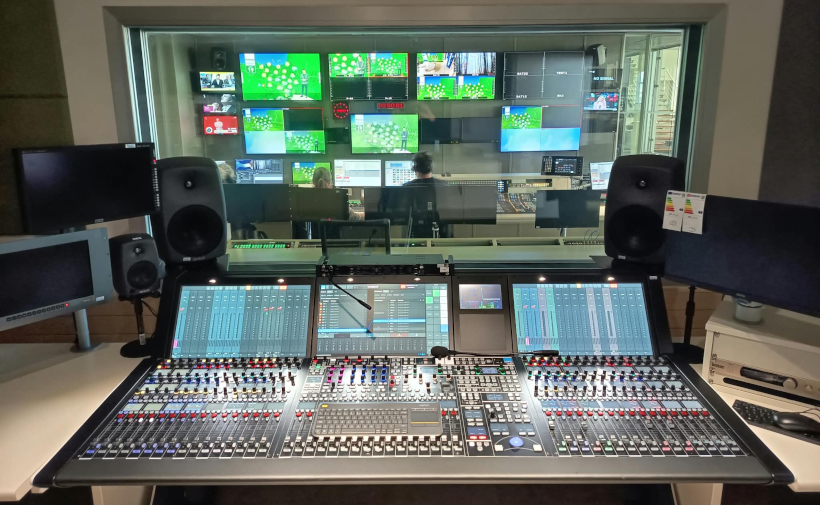
Euskal Irrati Telebista (EITB), the Basque Country’s public media group, has completed Phase 1 of its five-studio renewal with the commissioning of a Lawo IP audio infrastructure in Studio 3 at its Bilbao headquarters — Spain’s first installation to use the HOME mc² DSP app — establishing a software-defined foundation for the Bilbao and Miramon sites, while Phase 2 is already underway.
Telefónica´s “Servicios Audiovisuales” (TSA) with a strong track record in advanced broadcast transformation projects, has acted as SI for the project, leading the deployment and commissioning of the new IP-based audio infrastructure across EITB’s Bilbao and Miramon sites. The project includes a fully engineered architecture based on SMPTE ST 2110, with dedicated network, synchronisation and control layers ensuring seamless integration of audio processing, I/O and management systems within a unified environment.
TSA delivered a fully redundant and segmented network architecture, incorporating PTP-based synchronisation, dual network topologies and high-availability design principles. This approach enables dynamic resource allocation across studios, simplifies system operation and ensures a scalable and future-ready platform aligned with the transition towards software-defined production workflows.
At the heart of the upgrade is a 58‑fader mc²56 MkIII surface engineered for IP operation in a SMPTE ST 2110-native architecture with full support of AES67 and RAVENNA. In EITB’s configuration, the mc²56 MkIII does not rely on a traditional dedicated DSP core; instead, all mixing, routing and signal processing are executed by the HOME mc² DSP app running on redundant COTS servers, turning the surface into a fully IP‑native control layer tied to a virtualized compute backbone. This decoupling provides immediate elasticity, allowing EITB to pool DSP resources and reassign capacity between studios as demand shifts.
The HOME mc² DSP app currently delivers 512 fully equipped DSP channels and can be expanded by license to 2,048, enabling future Bilbao studios to come online without additional hardware. Beyond capacity gains, the software‑based model shortens commissioning, reduces physical failure points, and supports rapid workflow reconfiguration — benefits that align closely with the EBU’s Dynamic Media Facility (DMF) vision, where modular microservices and shared compute clusters power agile production. Lawo’s DMF‑aligned HOME Apps ecosystem illustrates how entire processing environments can be switched and scaled at the software layer, underscoring the future‑oriented nature of EITB’s investment.
A redundant cluster of Lawo’s HOME platform provides the IP‑native management and orchestration platform. Built on a cloud‑native microservices architecture, HOME handles device discovery, authentication, parameter control and secure stream routing, with native support for SMPTE ST 2110, AES67 and NMOS IS‑04/05 to onboard Lawo‑native and third‑party devices with minimal engineering effort. As EITB expands, the same control fabric can scale from single‑room operations to multi‑site management, allowing for a unified operational model across Bilbao and Miramon if required.
High‑density connectivity is ensured by multiple Power Core Gateway nodes that bridge legacy and IP domains. Each Gateway provides up to 512 RAVENNA/AES67/ST 2110‑30 channels plus 256 MADI channels and modular slots for MIC, Line, AES3, Dante and GPIO, making hybrid operation straightforward throughout the transition. AIOX extender frames add 64 channels per unit and scale to 1,280 channels per Power Core for large ingest or multi‑studio scenarios, giving EITB ample headroom without architectural change.
By combining a SMPTE ST 2110 transport core, the HOME orchestration layer and virtualized HOME mc² DSP processing behind the mc²56 MkIII surface, EITB is moving beyond a console replacement to a fully software‑defined audio infrastructure. The result is a resilient, scalable and agile environment that reduces complexity and cost, accelerates deployment, and positions the broadcaster to evolve rapidly with emerging formats, distributed production models and the DMF‑driven future of European media facilities.
And if the need should arise to upscale the system beyond their perpetual licensing, the platform also supports Lawo’s Flex licensing model for the temporary activation of additional HOME Apps and resources, if required. This pay‑as‑you‑grow approach aligns compute, I/O and feature sets with real production needs — ideal for seasonal peaks, special events or temporary studios — while avoiding sunk cost in idle hardware and improving long‑term TCO.