 How to resolve AdBlock issue?
 TopVision uses Sennheiser
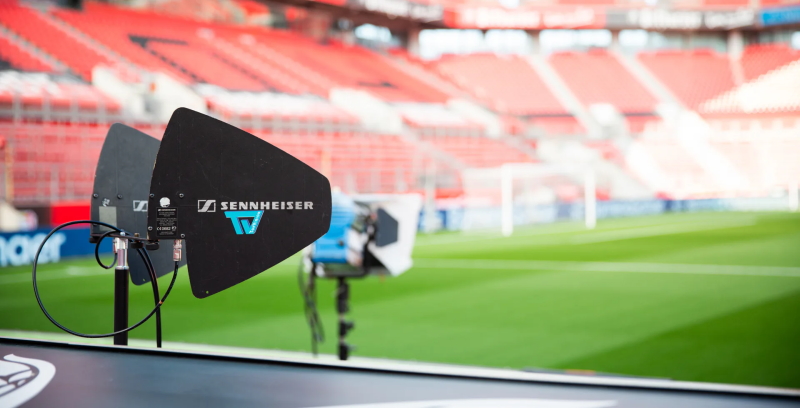
Before a German league football match is broadcast, sound engineer Ecki Kehrer and sound technician Daniel Kersten from production company TopVision go into action. Well established in sports and football productions for more than 30 years, TopVision has been an independently operating subsidiary of TVN Live Production since 2024, providing the commissioning producer Sportcast – and therefore German football fans – with thrilling outside broadcasts direct from the stadiums. Pitch microphones and wireless systems for interviews bring all the excitement of a live soccer match into TV and streaming audience’s living rooms. So what does a typical football Saturday look like for Kehrer and Kersten and what do they think of Sennheiser’s new MKH 8018 stereo shotgun microphone?
Commissioning producer Sportcast specifies the equipment to be used in the stadium to ensure that all league games are broadcast to a consistently high standard. “For the pitch, that means 17 microphones, three behind each goal, one in the centre and two directed towards the 5-metre corners,” explains Daniel Kersten. “Microphones are set up at all four corners, and at the main camera position (Camera 1), there are three microphones at the two 20-metre positions and at the half-way line, while on the opposite side there are four microphones at the 22-metre positions and at the 40-metre position. In addition, we also have ambience microphones to pick up the crowd noise.”
While MKH 8060 and MKH 8070 shotgun microphones were used as pitch microphones in the past, the new specifications now mean that MKH 8040 with a cardioid pick-up pattern are positioned around the edges of the pitch. As Kehrer points out: “You sometimes want to hear the ‘close balls’, in other words the sound of the players kicking the ball, but you also don’t want to be too focused, because the microphones are static and no one is moving them around, as would be the case with shotgun mics.” Kersten adds: “In our set-up, it’s the sheer number of microphones that makes all the difference. When you’ve got 17 microphones spread around the pitch, directionality is not that important. We do have directionality, of course, but because of the large number of microphones, it works really well with the short ones.”
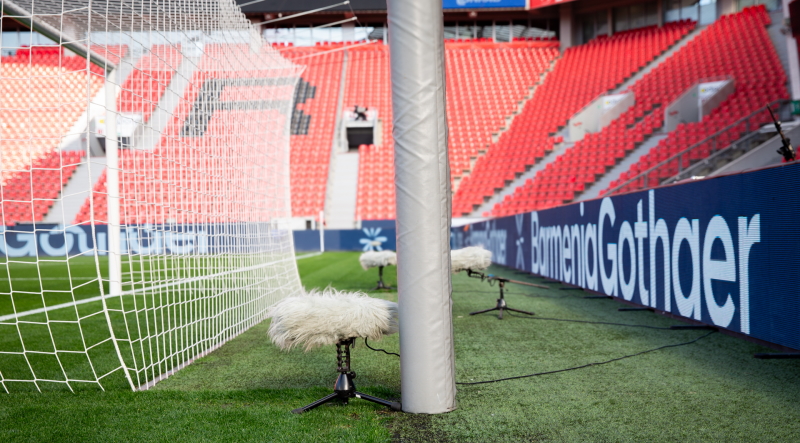
All microphone cables are connected to a rack at the edge of the pitch. A STAGETEC router linked to the OB van enables TopVision to provide 32 transmission channels in both directions. The microphones themselves can sometimes become unintended targets. “This occurs more often than you might think, especially when both teams are warming up on the pitch,” Kersten explains. “We start transmitting the broadcast signal an hour before the match kicks off, so all the microphones are already in place. And maybe three or four times in a season, one of the microphones gets kicked away. You’re either lucky and you can just put it back where it was. Or you’re unlucky and something gets broken.” Kehrer adds: “The microphones near the goal are particularly at risk. We’ve had players who liked to vent their frustration after a foul or after missing a goal by giving the microphone a good kicking. Unfortunately, things like that can happen occasionally.”
TopVision has around 20 cameras in use during a game, a quarter of which are handheld cameras equipped with wired shotgun microphones. While handheld cameras for interviews use mono microphones, MS stereo microphones are fitted to the handheld cameras that are used to show the players coming onto the field, arriving by bus, or waiting for the match in the locker room. “For example, we have an FX6 mounted on a gimbal, which means that you try to keep the weight down and use a microphone that’s as compact as possible,” Kersten explains. “Every gram of weight that you can save and every length that you can make shorter is, of course, always an advantage.” Kersten adds: “In the stadium, we now have the MKH 8018 in regular use on our FX6 and the gimbal, and we’re absolutely delighted by both the handling and the sound. Especially on the small gimbal, a few grams of weight make a huge difference – and combined with the sound quality, it’s perfect as a camera microphone for live broadcasting.”
Ecki Kehrer goes into more detail: “The microphone features very good left-right localisation and a very good frequency response, and therefore provides a very clean and open representation of what is going on in front of the camera. We found its directivity to be better than that of the predecessor model, the 418-S. We were able to “listen in” even more closely when the teams were choosing ends before the match began. We were also impressed by the bass response, which was almost too deep compared to an MKH 8060, but we prefer this because you can always remove low frequencies by using a high-pass filter at the console, but you can’t add them if they’re not there. During the tests, we also considered using the microphone as a close-ball mike in three directions: 45°L, M, 45°R, which would have been possible without any problems with a similar sound character to that of an 8060. All in all, the 8018 is a very convincing product that we really enjoy using.”