 How to resolve AdBlock issue?
Sennheiser Spectera for Snow Patrol
Pictures: Bradley Quinn

In September, Snow Patrol played three epic nights at the Royal Albert Hall in London, transforming the venue into a glittering rock location for the occasion, with special guests and ecstatic audiences. Utilising Spectera SEK bodypacks for IEMs and the brand-new Spectera SKM handheld microphones for vocals has brought a new dimension to the band’s sonic environment, and as Jamie Hickey, long-standing monitor engineer of the band, explains, “I genuinely think Spectera is the best thing that’s happened to live IEMs.”
After moving Snow Patrol onto the digital wideband system for in-ear monitoring, Hickey, who is also Co-Director of Production & Touring Ltd, added the new Spectera handhelds for the Royal Albert Hall performances. “I originally came to Spectera thinking about what it could do for IEMs,” recalls Hickey. “But once you have IEMs, handheld microphones and potentially instrument inputs all existing inside the same wideband environment, you realise that it isn’t simply a different way of doing in-ear monitoring. It’s a different way of thinking about wireless. You start thinking about Spectera as the wireless platform for the production.”
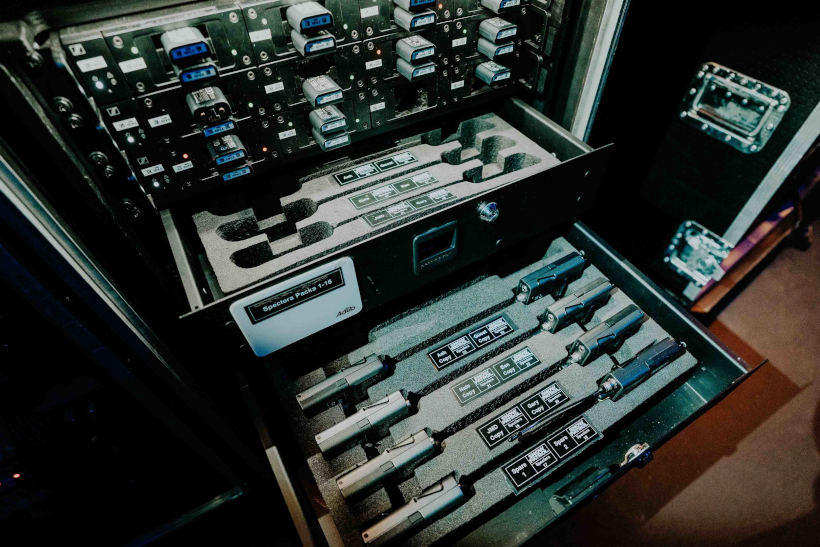
Max Taylor, Hickey’s monitor tech, details the set-up: “Three SKM handhelds were used for the lead vocal, a guest/spare vocal, plus a tech talk microphone. All of the band’s IEMs were on Spectera; we were running 24 packs for the show, carrying 14 unique stereo mixes. This was a mix of five band packs, five band copy packs, two guest packs, a load of tech mixes, a few management mixes, PFL, and a monitor tech pack.” Hickey adds: “The copy packs are particularly clever. We can have duplicate packs for band members and guests, plus additional copies of tech mixes, without those receivers consuming additional channel capacity. They’re simply receiving an existing mix.”
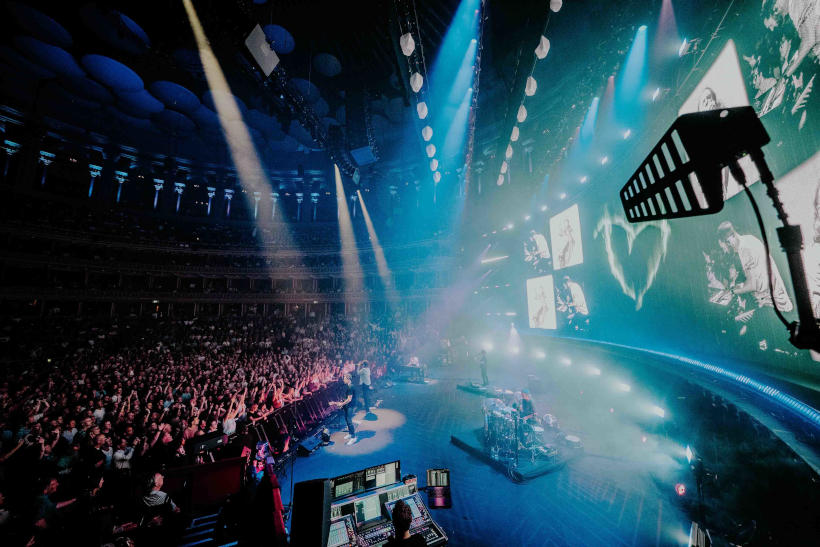
Taylor was running three Spectera DAD transceiving antennas, one on stage left and one on stage right, utilising a cross-stage CAT cable that he had loomed in with the other signal looms for the inputs that came off stage right. The Base Station and the main system were located underneath the choir stalls, so a third antenna was positioned here to help provide additional coverage for some of the backline techs who were out of line of sight of the main SL and SR antennas.
“Being able to add another antenna seamlessly and direct it towards those members of the crew, gave us additional coverage in an area that might have been difficult to cover with just the two main antennas we were using for the stage,” explains Taylor. “We also had a large video wall that, on a scan of the RF environment, showed low-level artefacts. Although the signal was so low that it didn’t cause us any issues, it was great to be able to monitor it in real time through the scan, and also the Spectera antenna readings.”
“We managed to fit the whole show into a single wideband channel,” says Taylor. “This allowed us to utilise all the antenna ports on the Base Station within a single RF channel, giving us enormous flexibility in how we wanted to run our antenna layout for the show. The ability to add extra antennas to supplement the system so easily is incredibly useful.”
Fitting the whole IEM package into one 8 MHz RF carrier was important for Hickey to also give the team flexibility when travelling. “When you’re bouncing around the world through very different RF environments, that’s brilliant,” says Hickey. “With a conventional narrowband system carrying that number of stereo IEM mixes, you could easily end up effectively block-booking a similar amount of spectrum. Here we can find a suitable 8 MHz channel, put the whole Spectera IEM system inside it, and we’re done.”
Hickey and Taylor mostly used the ‘Live Stereo’ Audio Link Mode for in-ears, with a few in ‘Live Link Density’ for some of the crew members. The mics were running in ‘Live’ mode, with the Tech microphone running in ‘Live Link Density’. “Once that’s decided, it’s as simple as putting our coordinated frequency into the Base Station unit and we’re good to go,” says Taylor. “Not having to sync 24 packs every day has freed up a lot of time in the day-to-day workflow.”
The band’s response to the Spectera in-ear sound “has basically been ‘Wow’”, says Hickey. “The first thing you notice is how open everything feels. There’s this huge soundscape, and you really hear every detail of what you’re doing. It’s such a joy to mix with.”
Hickey was surprised by the bottom end of the IEM audio, enabling him to lower some of the high-pass filters and let more of the fundamental through on kick drums, bass and toms, for example. “At one point during rehearsals, I genuinely had to check that there wasn’t a sub running in the room, because of the amount of low end I was hearing through the IEMs,” says Hickey. “But it doesn’t feel hyped. There isn’t some enormous EQ bump creating artificial bottom end. It’s just this lovely, pure extension downwards. ‘Natural’ is probably the word I keep coming back to with Spectera. It feels incredibly natural.”
Peter Craig, Sennheiser’s Artist Relations Manager, has worked closely with Hickey and the team throughout the rollout. For him, Snow Patrol’s experience reflects exactly what Spectera was designed to deliver. “What Jamie and Snow Patrol have achieved is a perfect example of why we built Spectera,” Craig says. “It was about removing the compromises engineers and artists have learned to live with for decades, be it on in-ear sound, RF footprint or system design. Hearing Jamie say that the band hears more and they respond differently is the most rewarding feedback we could ask for, and we are proud to be part of that journey with them.”
Hickey concludes, “I’ve probably been singing and dancing about Spectera for the last 18 months to the point where some people might wonder whether I actually work for Sennheiser! But that enthusiasm comes from actually using it. The fundamental platform is incredibly solid. It’s dependable, it’s reliable, and it sounds fantastic. Whatever evolution it takes from here, everything is being built on top of those fundamentals. That’s what makes me excited about where it goes next.”