 How to resolve AdBlock issue?
 SonicWorld Telsie S
Siemens W295b Equalizer Plug-In
Author: Peter Kaminski | Photos: Archive
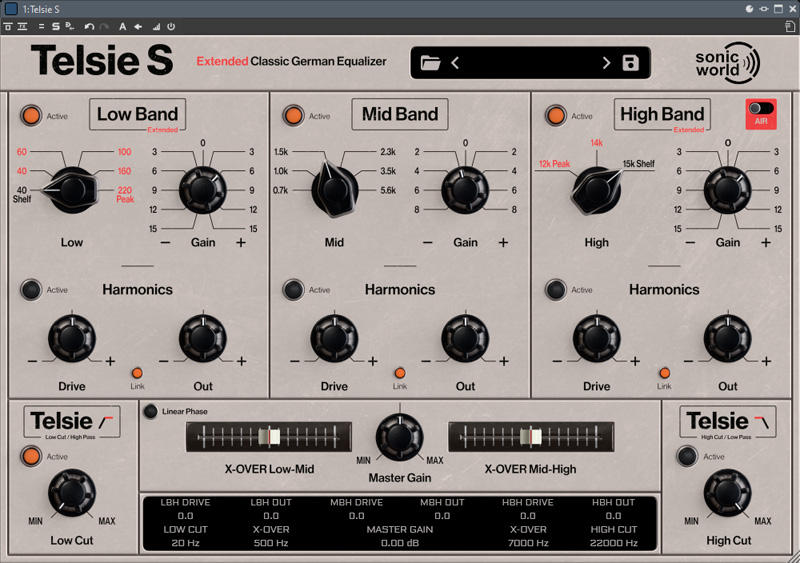
Many equalizers and filters from the 70s and 80s are legendary, including the Siemens W295b presence/absence filter, which was offered as a Sitral cassette module. Now the W295b is also available as “Telsie S” from the new German manufacturer SonicWorld. The plug-in was introduced at the beginning of 2026.
Requirements and Installation
The plug-in is available for Windows-based DAWs, for macOS in VST3 and AAX formats, as well as for macOS in AudioUnit format.
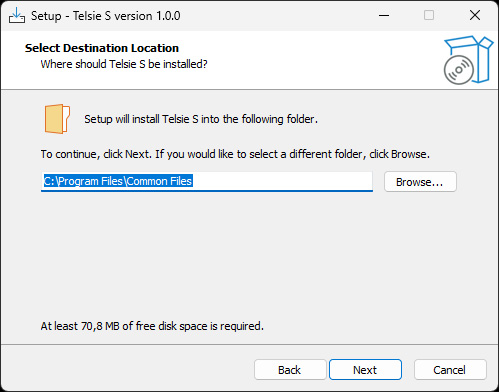
An installer software is provided for installation.
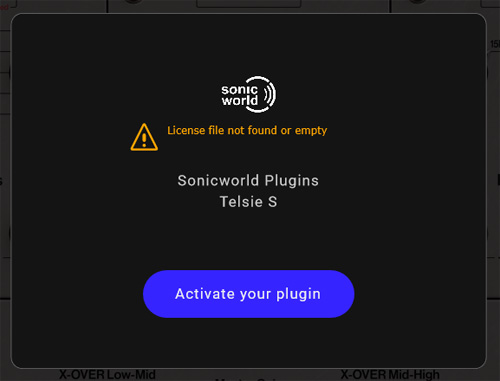
After installation and the first time you launch the plug-in, you must activate it for your computer. The plug-in can be used on a maximum of two computers at the same time.
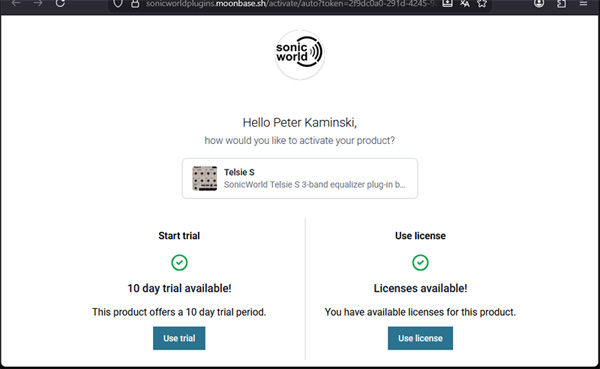
Activation is then carried out through your user account at SonicWorld. The plug-in can also be installed for a 10-day trial period.
Siemens W295b Sitral Cassette

Behind SonicWorld is Jean Hund, who, through his distribution company Akzent Audio, has represented several well-known brands - such as Crane Song - in Germany for many years. SonicWorld has decades of experience converting audio modules and cassettes to the 19-inch format, including the W295b (see image above). But slowly, the sources are drying up and the prices for the old devices are skyrocketing. A single W295b cassette can cost up to 2,000 euro - and then it may still need to be restored and installed in a 19-inch rack. So what could be more obvious than transferring the experience gained with the module into software? Many others have already done this, such as Arturia, SoundToy, and Korneff. Sonic World is not the first, but it has a lot of experience in this area.
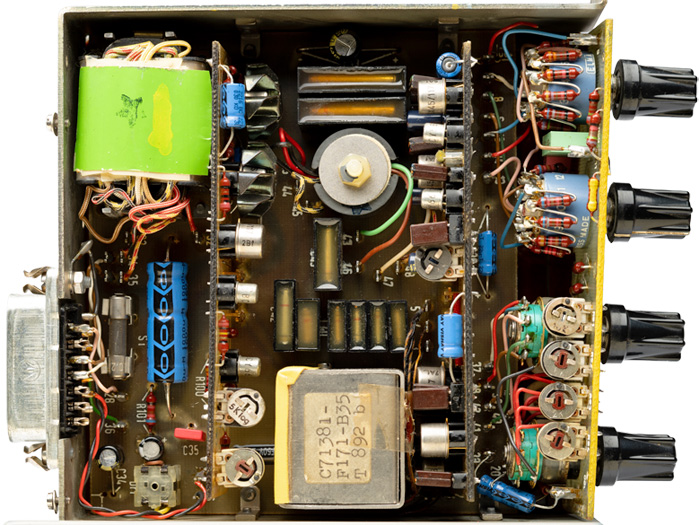
The transition from tube to transistor technology began in the 1970s. The W295b cassette uses low-noise silicon transistors of the types BSX45/10, BCY66, and BCY58 from Siemens. The resistors used had a tolerance of two percent and a temperature coefficient of 200 ppm. By the standards of the time, these were all very high-quality components, which is not surprising, as Sitral cassette technology was designed for use in broadcasting, where only the best of the best was ever used. Compared to digital technology, there is, of course, a certain amount of variation and slight differences in sound from module to module, due to the tolerances of the capacitors in the RC networks, for example. The amplifier is built using Class A technology with input and output transformers. The 24-volt power supply also ensures adequate headroom.
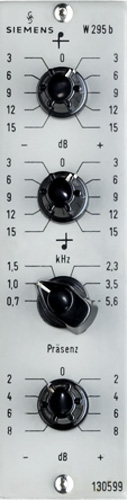
The W295b offered three filters: a shelving filter for boosting or reducing (+/- 15dB in 3dB steps) the bass and treble, and a bandpass/notch filter with a switchable center frequency from 0.7 to 5.6kHz in six steps (+/- 8dB in 2dB steps). So the original offers very straightforward control options.
Operation
Let's now turn to the software implementation of the W295b in the form of the Telsie S plug-in from SonicWorld. The plug-in size can be adjusted continuously with the mouse.
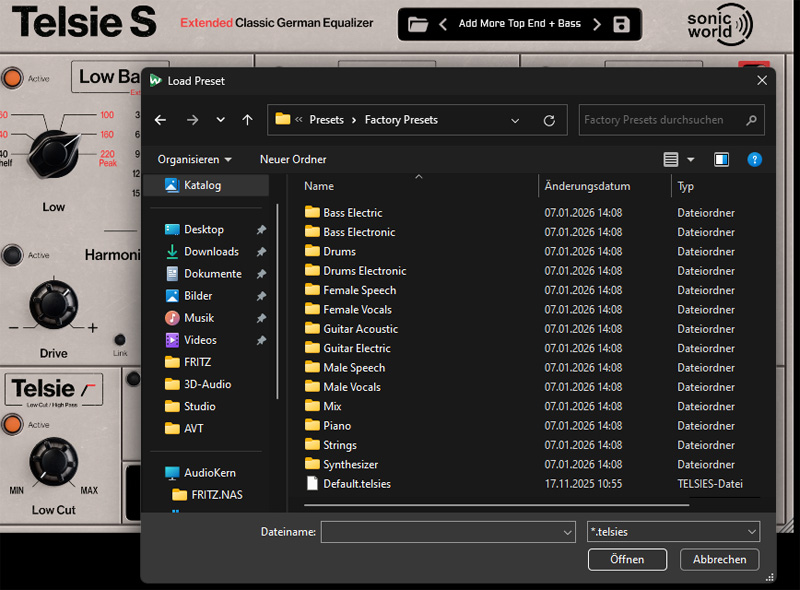
At the top of the header, you can select a preset using two arrows or directly by selecting a preset file (see figure above).
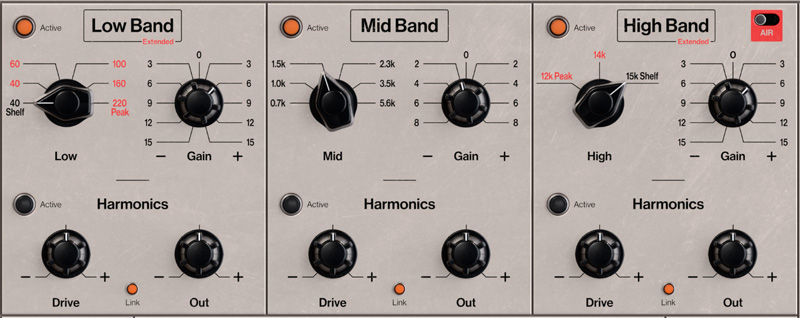
Just by looking at the upper half of the plug-in, it becomes clear that you have access to a lot more here than with the original filter. In addition to the low and high shelving filters, peak filters can also be used, with five additional frequencies for the low filter and two additional frequencies for the high filter. The new options are marked in red. Each band can be activated or deactivated individually.
Another new feature is the individually switchable harmonics function for the three bands. The “Drive” knob sets the strength of the harmonics, and the ‘Out’ parameter sets the level added to the original signal. The “Link” button can be used to link the Drive and Out knobs so that they change each other. Increasing the output level reduces the drive by the same amount.
The “AIR” switch extends the frequency response of the high filter to higher frequencies. However, this is particularly noticeable at sample rates higher than 44.1kHz in the DAW.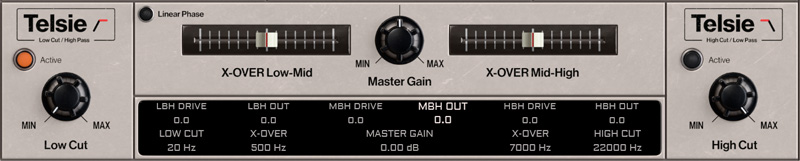
The lower half now features two additional enhancements compared to the original: individually switchable low-cut and high-cut filters (filter slope 12dB/oct.) with adjustable cutoff frequencies (20Hz to 22kHz). The crossover frequencies to the midband (100Hz to 1.2kHz and 5.6 to 20kHz) can then be changed. The set values are displayed as numbers in a display field at the bottom. The master output level can also be adjusted using a knob.
The first update was released shortly after the initial release. Among other things, the “Linear Phase” function was added. More on this in the practical section.
In Practice
The plug-in was tested in version 1.1.1 as a VST3 plug-in under Windows 11 in WaveLab 13 and Nuendo 14 on an AudioKern B14 DAW from Digital Audio Service. The plug-in does not require a lot of CPU resources. In WaveLab 13, adding the plug-in to the processing chain increased the load in the Windows Task Manager from 0.8 percent to 1.6 percent. In Nuendo, the performance indicator rose from a base value of approximately 7 percent to 10 percent when the plug-in was activated. So everything is very moderate in terms of CPU usage. The installation process is straightforward and simple.
All three filter bands offer very good control options. The bass range can be worked out very nicely and precisely. The same applies to the treble. It gets particularly interesting when you use the options that go beyond the capabilities of the original. These include the additional filters for the low and high bands, but I particularly liked the variable band crossover frequencies. Here, it is advisable to change the X-Over Low-Mid downward and the Mid-High upward. This allows you to work even more precisely on the bass and treble. Incidentally, there is now a somewhat hidden linear phase switch. This was not available in version 1.0 of the plug-in, and the phase was slightly affected. When activated, it more closely resembles the original behavior. However, I would still recommend switching off the linear phase as an alternative and listening to the difference. Sometimes I even liked it better that way.
The range of applications is very broad, and you can certainly use the EQ in a channel strip. However, I would recommend using it in a bus master or master channel strip - or even for mastering. Especially with WaveLab 13, you can get even more out of existing and already mastered material. With the appropriate settings, the highs sound very “silky”. Thanks to the many additional options, such as X-OVER and Harmonics, or the individual activation switches for each individual band, the results are clearly better than with the original. This is what really sets the Telsie S apart: the excellent basic sound of the original combined with new, additional possibilities. This is what I miss in plug-ins from other manufacturers that simulate the W295b but leave it at a pure simulation and thus also inherit all the weaknesses of the original. The Telsie S takes a different approach here.
Conclusion
The price for Telsie S is 129 euros/US$, which is absolutely reasonable. The concept and implementation are convincing because they combine the existing with the new, true to the motto: what is good can be made even better. On one hand, the W295b filter has been simulated very well, but the new options that go beyond the W295b functionality enrich the plug-in enormously. For anyone who wants to make optimizations in the bus, in the master, or even in the mastering process itself, the Telsie S is exactly the right choice.